Personally, Treeverse shows that sustainable game economies require more than just ownership.#GameFi #Web3Gaming
Quick Video Breakdown: This Blog Article
This video clearly explains this blog article.
Even if you don’t have time to read the text, you can quickly grasp the key points through this video. Please check it out!
If you find this video helpful, please follow the YouTube channel “GameFi+Plus,” which delivers daily news.
https://www.youtube.com/@GameFiPulse
Read this article in your native language (10+ supported) 👉
[Read in your language]
Treeverse Season 2: Tokenomics Deep Dive and Economic Sustainability in a Cross-Platform GameFi MMORPG
🎮 Gameplay Type: MMORPG
👍 Recommended For: Tokenomics analysts, game economy researchers, advanced Web3 investors
In the evolving landscape of GameFi, where blockchain integration promises decentralized economies within virtual worlds, Treeverse stands out as a case study in balancing gameplay with token-driven incentives. Launched by Endless Clouds, this MMORPG has progressed from its alpha stages to a full cross-platform release on PC and mobile, coinciding with preparations for Season 2. Structurally, Treeverse matters because it attempts to merge traditional gaming elements—like real-time combat and classless progression—with Web3 features such as NFT ownership and the $END token. This analysis draws from recent developments, including the token’s launch in July 2025 and its performance, to evaluate the project’s economic design and long-term viability. By examining its tokenomics, we can assess whether Treeverse avoids common GameFi pitfalls like hyperinflation or unsustainable rewards, providing a lens into broader industry trends as reported in sources like Delphi Digital’s 2025 investment overview.
The “Before” State: From Web2 Limitations to GameFi Potential
Traditional Web2 games, such as World of Warcraft or Fortnite, operate in closed ecosystems where players invest time and money into assets that remain locked within the publisher’s servers. There’s no true ownership—skins, items, and progress can vanish if the game shuts down, representing a classic sunk cost. In contrast, GameFi projects like Treeverse introduce blockchain-based ownership via NFTs, enabling secondary markets where players can trade assets like character gear or land parcels on platforms such as OpenSea. This shift theoretically creates a player-driven economy, but it also introduces risks like token volatility, as seen in Treeverse’s $END token launch, which experienced significant sell pressure according to GAM3S.GG reports. The key structural advantage is the potential for sustainable value accrual, though it demands robust design to prevent exploitation.
Core Mechanism: Tokenomics and Economic Design
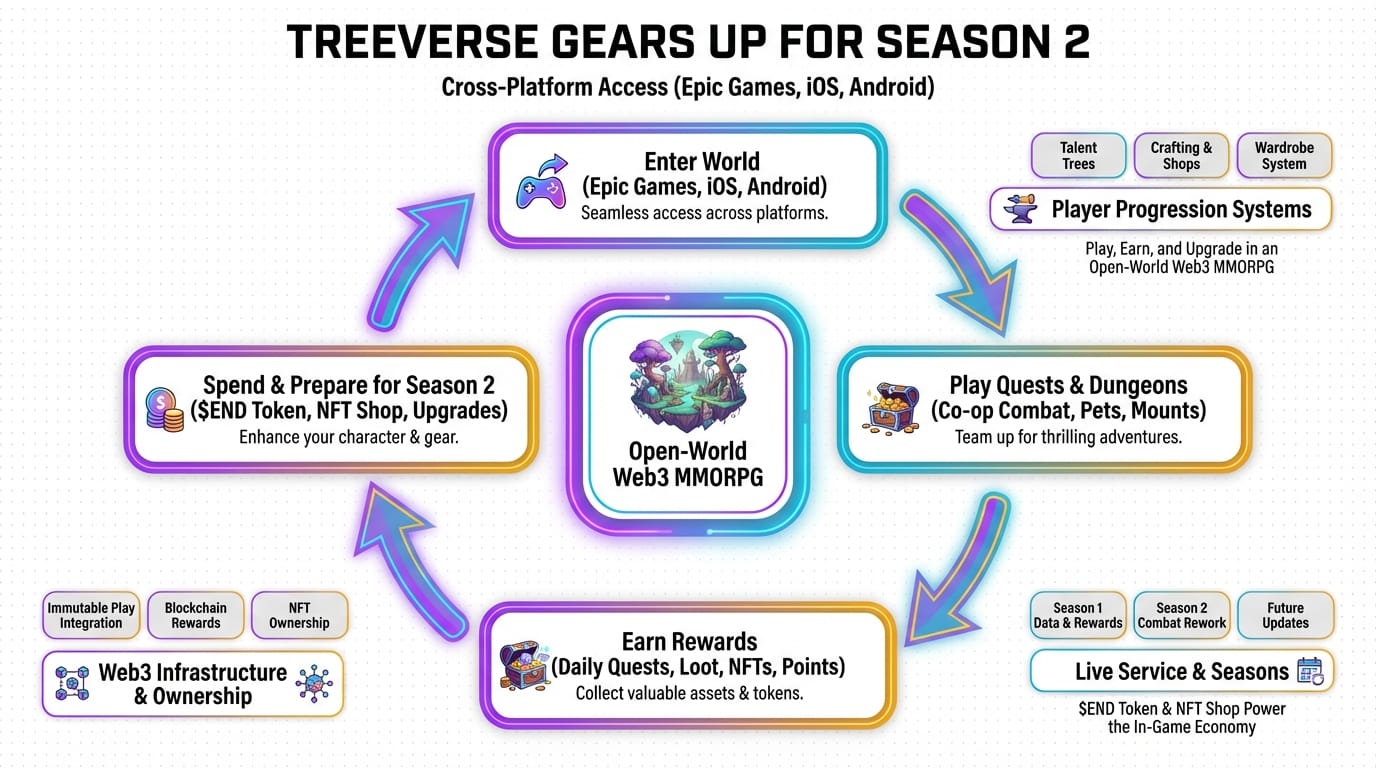
Treeverse’s tokenomics revolve around the $END token, launched on Ethereum L1 with a bridge to Immutable zkEVM in July 2025, as detailed in PlayToEarn and GameFi reports. The economy features emission through seasonal rewards and airdrops, primarily rewarding active players and NFT holders from Season 1. Key mechanisms include token sinks—such as in-game purchases for upgrades or staking for governance—to counter inflation, which is critical given the token’s initial flop, where sell pressure led to a rapid valuation drop per GAM3S.GG analysis.
The design aims for balance: emissions are tied to gameplay milestones, like quests or PvP events, encouraging participation without flooding the market. However, sustainability hinges on factors like token velocity and external market conditions. Long-term risks include over-emission if player growth stalls, as seen in broader GameFi investment declines of 55% in 2025 per BitcoinWorld. Treeverse mitigates this with optional NFT integration, where assets enhance progression but aren’t mandatory, potentially broadening appeal while maintaining economic integrity.
Use Cases / Participation Styles
Participation in Treeverse can vary based on user goals, each with its own economic implications. One style involves active gameplay for rewards: players engage in daily quests and events to earn $END tokens, which can be used for in-game enhancements or traded on secondary markets, though outcomes depend on token liquidity and demand.
A second approach is NFT-focused collecting: users acquire and hold Treeverse NFTs, such as character avatars or items, to claim airdrops or participate in governance, leveraging the project’s Immutable zkEVM integration for low-fee transactions. This style suits those monitoring long-term asset appreciation, influenced by community support and development updates.
Finally, a passive staking style allows token holders to lock $END for yields or bonuses, contributing to network stability but exposing them to volatility risks from market fluctuations, as evidenced by the token’s post-launch performance.
Comparison: Traditional Web2 Games vs. Treeverse GameFi
| Aspect | Traditional Web2 Game | Treeverse (GameFi Project) |
|---|---|---|
| Ownership | Publisher-controlled; assets non-transferable and at risk of loss if servers close. | Blockchain-based NFTs provide true ownership, tradable on open markets. |
| Progression | Time-based grinding with in-app purchases that offer no resale value. | Classless system with optional NFT boosts; progression can yield tradable rewards. |
| Economy Design | Centralized, with revenue flowing solely to developers; no player-driven markets. | Decentralized with $END token sinks and emissions; player activity influences supply/demand. |
Conclusion
Treeverse offers valuable insights into GameFi design, particularly its tokenomics that emphasize balanced emissions and sinks to foster sustainability. Strengths include its cross-platform accessibility and integration with Immutable zkEVM, which could support long-term adoption. However, structural risks—such as token inflation from unchecked rewards or dependency on community engagement—remain, as highlighted by the $END launch’s challenges and industry-wide investment drops. Ultimately, outcomes depend on player behavior, market conditions, and ongoing development; participants should approach with caution, verifying on-chain data and starting small to assess viability.

👨💻 Author: SnowJon (Web3 & AI Practitioner / Researcher)
A researcher leveraging insights from the University of Tokyo Blockchain Innovation Program to analyze GameFi, Web3, and digital economies from a practical and structural perspective.
His focus is on translating complex systems into frameworks that readers can evaluate and think about critically.
*AI may assist with drafting, but final verification and responsibility rest with the human author.
References & Further Reading
- Treeverse Gears Up for Season 2 as Game Goes Live on PC and Mobile
- Treeverse $END Tokenomics Details and Seasonal Rewards Announced
- Treeverse Is Set to Launch $END TGE on July 4
- Treeverse Season 1 Ends Strong, $END Token Launch Set for June
- Why Treeverse’s $END Token Launch Flopped
- GameFi Investment Plummets 55% in 2025: A Brutal Reset for Blockchain Gaming