Personally, The Sandbox on Base suggests accessibility remains the primary driver for retention#TheSandbox #GameFi
Quick Video Breakdown: This Blog Article
This video clearly explains this blog article.
Even if you don’t have time to read the text, you can quickly grasp the key points through this video. Please check it out!
If you find this video helpful, please follow the YouTube channel “GameFi+Plus,” which delivers daily news.
https://www.youtube.com/@GameFiPulse
Read this article in your native language (10+ supported) 👉
[Read in your language]
The Sandbox’s Base Integration: Analyzing $SAND Expansion and Onchain Onboarding for Sustainable GameFi
🎮 Gameplay Type: Metaverse Builder / Sandbox
👍 Recommended For: Tokenomics Analysts, Web3 Researchers, Long-term GameFi Strategists
In the evolving landscape of GameFi and blockchain-based metaverses, The Sandbox stands out as a platform that has consistently pushed boundaries since its inception. The recent integration with Base—an Ethereum Layer-2 network developed by Coinbase—marks a pivotal shift aimed at expanding access to the $SAND token and streamlining onchain onboarding. This move isn’t just about technical upgrades; it addresses core challenges in scalability, user accessibility, and economic design within decentralized gaming ecosystems. Drawing from market trends in 2025 and 2026, where GameFi projects are increasingly scrutinized for sustainability amid volatile token markets, this integration positions The Sandbox to potentially mitigate some of the inflation risks that have plagued similar platforms. We’ll dissect the tokenomics, economic mechanisms, and long-term viability, using data from sources like Messari reports and official announcements to provide an objective lens on why this matters for advanced users and researchers.
The “Before” State: Web2 Gaming vs. GameFi Realities
Traditional Web2 games, such as Fortnite or Roblox, operate in centralized ecosystems where players invest time and money into virtual assets that ultimately belong to the platform owners. Think of spending hours grinding for rare skins or building elaborate worlds, only to lose everything if the servers shut down or terms of service change—it’s essentially a sunk cost with no true ownership or resale value. In contrast, GameFi projects like The Sandbox introduce blockchain elements, allowing players to own NFTs representing land, assets, or experiences that can be traded on secondary markets. This shift promises economic agency but comes with its own pitfalls, such as token volatility and dependency on network effects. Prior to the Base integration, The Sandbox relied heavily on Ethereum and Polygon, which, while robust, often led to high gas fees and fragmented liquidity, deterring mass adoption and complicating the token economy.
Core Mechanism: Token Economy and Design
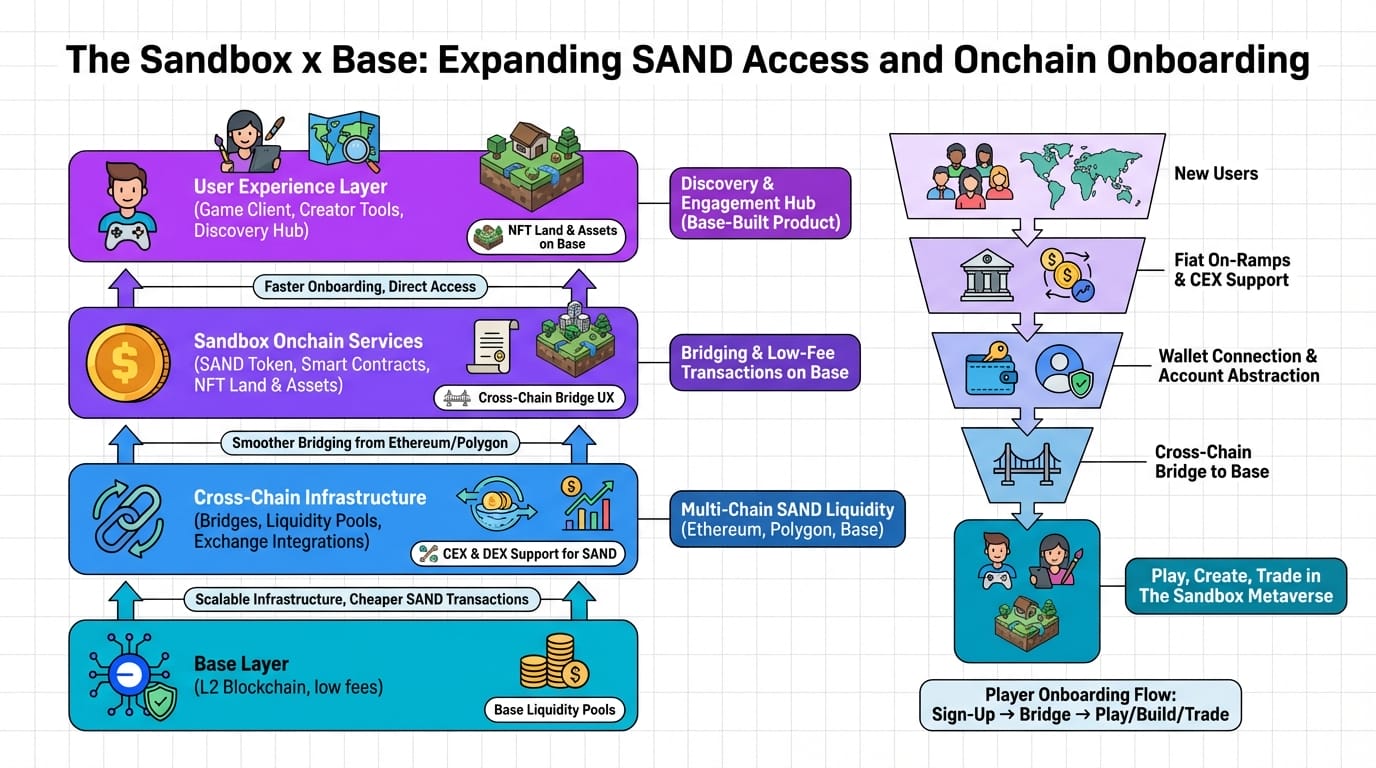
The heart of The Sandbox’s economy revolves around the $SAND token, which serves as the utility token for transactions, governance, and incentives within the metaverse. Tokenomics here are designed with a total supply cap of 3 billion $SAND, with emissions tied to gameplay rewards, staking, and ecosystem grants. However, sustainability hinges on effective token sinks—mechanisms that remove tokens from circulation, such as fees for land purchases, asset minting, or in-game events—to counter inflation from rewards. The Base integration enhances this by enabling low-cost bridging and liquidity pools on Base, reducing friction for new users and potentially increasing token velocity without exacerbating sell pressure.
From an analytical standpoint, the emission schedule is critical: As per The Sandbox’s whitepaper and recent Messari reports (e.g., Q1 2025 Brief), approximately 40% of $SAND is allocated to ecosystem development and rewards, with vesting periods for team and advisors to prevent dumps. Base’s optimistic rollup technology lowers transaction costs, which could boost onchain activity—think faster staking rewards or NFT trades—while integrating with Base’s DeFi ecosystem for yield farming opportunities. Yet, risks loom: If adoption doesn’t scale, we could see hyperinflation similar to early GameFi failures, where token supply outpaces demand. Long-term, the project’s shift to Sandchain (a custom Layer-2) as outlined in 2025 updates aims to further decentralize governance, but it introduces dependencies on Base’s security model, which relies on Ethereum for finality.
Use Cases / Play Styles
For advanced users, participation in The Sandbox via Base isn’t about quick flips but strategic engagement. One realistic style is the ecosystem builder, where researchers or developers acquire virtual land NFTs on Base for low fees, then create and monetize experiences—earning $SAND through player visits or asset sales, though outcomes depend on community interest and market liquidity.
Another approach is the token staker and governance participant: Users bridge $SAND to Base, stake it for yields (potentially 5-10% APY based on 2025 data), and vote on DAO proposals. This style suits analysts monitoring economic health, as staking acts as a sink, but it’s vulnerable to governance attacks or reward dilution if participation drops.
Finally, the cross-chain arbitrageur leverages Base’s liquidity to trade $SAND across Ethereum, Polygon, and Base, capitalizing on price discrepancies. This requires monitoring on-chain data via tools like Dune Analytics, but it’s high-risk due to impermanent loss in liquidity pools and broader crypto market swings.
Comparison: Traditional Web2 Game vs. This GameFi Project
| Aspect | Traditional Web2 Game (e.g., Roblox) | The Sandbox (GameFi with Base Integration) |
|---|---|---|
| Ownership | Platform-controlled; assets can be revoked or lost on shutdown. | True ownership via NFTs on blockchain; transferable across wallets. |
| Progression | In-game levels and items reset or devalue without economic incentives. | Progress tied to $SAND earnings and NFT upgrades, with potential real-world value. |
| Economy Design | Centralized monetization; revenue flows to developers only. | Decentralized with token sinks, staking, and cross-chain liquidity for balanced inflation. |
Conclusion
The Sandbox’s integration with Base offers valuable lessons in designing resilient GameFi economies, emphasizing low-barrier onboarding and efficient token flows to foster sustainability. Strengths include enhanced accessibility for creators and a robust token sink model that could stabilize $SAND’s value over time, as evidenced by 2025 metrics like 144,000 new players and 7.9 million quests completed. However, structural risks persist, such as dependency on Base’s scalability, potential for token dilution if emissions aren’t matched by demand, and broader market volatility affecting NFT liquidity. Ultimately, outcomes hinge on player behavior, adoption rates, and external crypto conditions—approach with caution, verify on-chain data, and evaluate based on your risk tolerance.

👨💻 Author: SnowJon (Web3 & AI Practitioner / Researcher)
A researcher leveraging insights from the University of Tokyo Blockchain Innovation Program to analyze GameFi, Web3, and digital economies from a practical and structural perspective.
His focus is on translating complex systems into frameworks that readers can evaluate and think about critically.
*AI may assist with drafting, but final verification and responsibility rest with the human author.
▼ AI tools to streamline research and content production (free tiers may be available)
Free AI search & fact-checking
👉 Genspark
Recommended use: Quickly verify key claims and track down primary sources before publishing
Ultra-fast slides & pitch decks (free trial may be available)
👉 Gamma
Recommended use: Turn your article outline into a clean slide deck for sharing and repurposing
Auto-convert trending articles into short-form videos (free trial may be available)
👉 Revid.ai
Recommended use: Generate short-video scripts and visuals from your headline/section structure
Faceless explainer video generation (free creation may be available)
👉 Nolang
Recommended use: Create narrated explainer videos from bullet points or simple diagrams
Full task automation (start from a free plan)
👉 Make.com
Recommended use: Automate your workflow from publishing → social posting → logging → next-task creation
※Links may include affiliate tracking, and free tiers/features can change; please check each official site for the latest details.