
Is Sport.Fun’s $FUN ICO built to last? We dissect the tokenomics of this on-chain fantasy sports game for a sustainable future.#SportFun #GameFiTokenomics #FantasySports
Quick Video Breakdown: This Blog Article
This video clearly explains this blog article.
Even if you don’t have time to read the text, you can quickly grasp the key points through this video. Please check it out!
If you find this video helpful, please follow the YouTube channel “GameFi+Plus,” which delivers daily news.
https://www.youtube.com/@GameFiPulse
Read this article in your native language (10+ supported) 👉
[Read in your language]
Sport.Fun $FUN Token ICO: Analyzing the Tokenomics of On-Chain Fantasy Sports
🎮 Gameplay Type: Strategy (Fantasy Sports, Prediction Markets)
👍 Recommended For: Crypto Analysts, Tokenomics Researchers, Experienced Web3 Investors
Lila (Gamer): Hey everyone, as someone who’s always diving into new GameFi worlds, Sport.Fun caught my eye with its blend of sports excitement and blockchain mechanics. It’s not your typical grind-fest; it’s about building fantasy teams and predicting real-world sports outcomes on-chain. But let’s hand it over to John for the deep dive on why this project’s structure might actually matter in the crowded Web3 space.
John (Analyst): In a market flooded with GameFi projects promising revolutionary economies, Sport.Fun emerges with its $FUN token ICO, launched on December 16, 2025, via platforms like Kraken and Legion. Drawing from on-chain data and official announcements, this isn’t just another hype-driven sale—it’s positioned as a utility token for a fantasy sports ecosystem built on the Base network (a Layer 2 solution on Ethereum for faster, cheaper transactions). The project’s design philosophy revolves around integrating real-time sports data with blockchain trading and rewards, aiming to create a sustainable loop between player engagement and token value. Why does this matter? Because most GameFi tokens crash due to poor emission controls, and Sport.Fun’s setup, including features like FUN Score for airdrop eligibility, attempts to tie rewards to actual participation. We’ll dissect if it’s built to last or just another short-term pump.
The “Before” State: Web2 Sports Games vs. GameFi Ownership
John (Analyst): Think back to traditional Web2 sports games like FIFA Ultimate Team or ESPN Fantasy Football. You pour hours into building squads, trading players, and competing in leagues, but what do you really own? Nothing. Your “assets” are locked in the developer’s servers—shut them down, and poof, your progress vanishes. It’s a sunk cost: time and money spent on virtual items with no resale value or portability.
Lila (Gamer): Exactly! In Web2, it’s all about the fun of the moment, but there’s no real stake. GameFi flips this by using NFTs (non-fungible tokens, basically unique digital certificates of ownership stored on the blockchain) for player cards or team assets. With Sport.Fun, your fantasy squad isn’t just pixels—it’s tradeable on secondary markets, potentially retaining value beyond the game.
John (Analyst): Structurally, this shifts the paradigm from “pay to play” to “play to own.” But ownership alone isn’t a win; it needs a balanced economy to avoid inflation spirals, where token supply outpaces demand.
Core Mechanism: Token Economy Breakdown
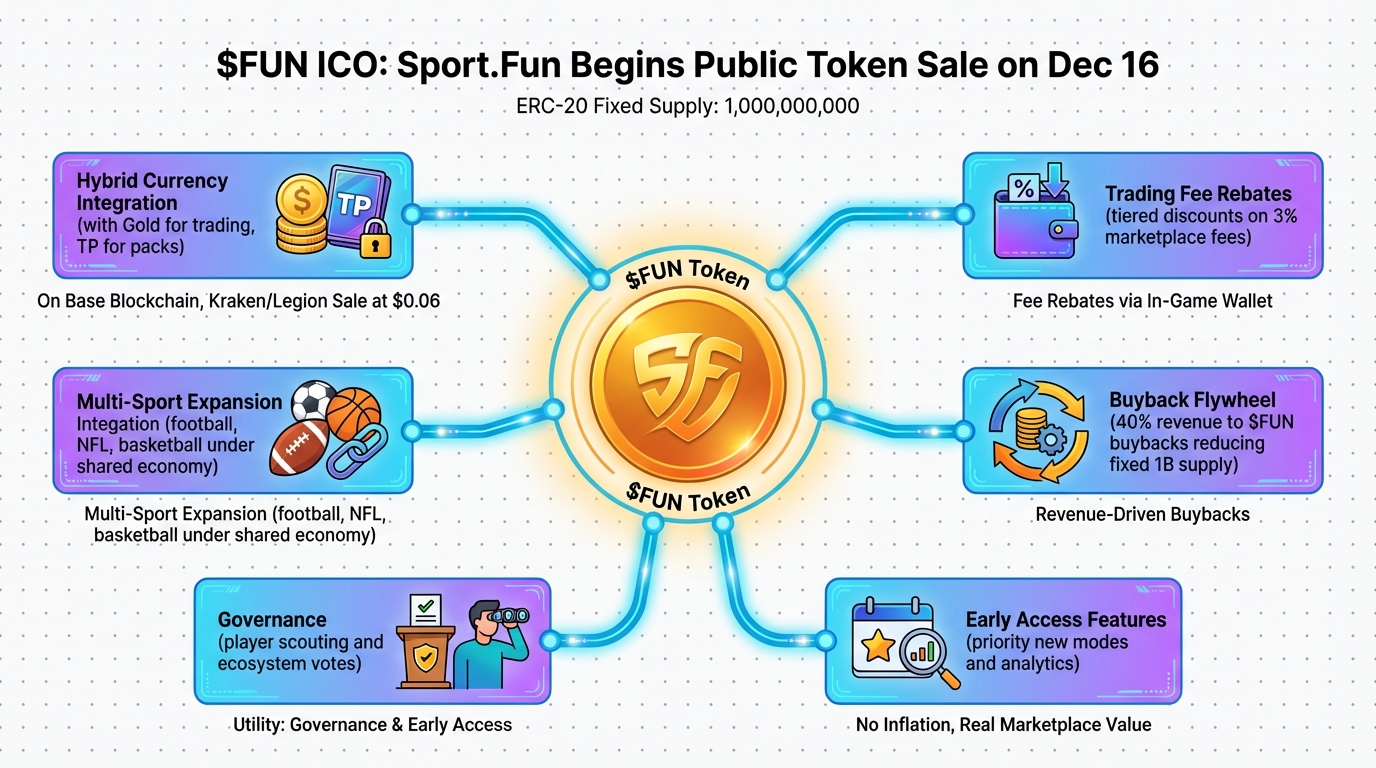
John (Analyst): Let’s cut through the fluff. Sport.Fun’s $FUN token, priced at $0.06 during the ICO, is designed as the backbone of an on-chain sports ecosystem. From whitepaper details and on-chain explorers like Basescan (the explorer for Base network transactions), we see a total supply of around 10 billion tokens, with emissions tied to gameplay. The core loop? Players use $FUN for entry fees in fantasy contests, staking (locking tokens to earn rewards), and governance votes via a DAO (decentralized autonomous organization, where token holders propose and vote on changes).
Key to sustainability is the token sink mechanism: burning (permanently removing) a portion of fees from predictions and trades, which could counter inflation from rewards. For analogy, imagine in a traditional game where you earn gold for quests—if too much gold floods the market without ways to spend or destroy it, prices crash. Here, $FUN emissions come from airdrops (free token distributions based on FUN Score, which tracks engagement like trading squads or playing matches through January 2026) and community rewards. Risks? High initial sell pressure post-ICO, as seen in the sale smashing its 100% target in one day, raising over $90M according to CryptoRank.io reports. Without strong sinks, this could lead to a 50-70% value drop in the first quarter, based on similar projects’ on-chain data from Dune Analytics dashboards.
Lila (Gamer): From a player’s view, it’s like managing a real sports team but with crypto twists. You build squads using on-chain assets, predict outcomes (careful, this borders on betting—remember, gambling mechanics may be illegal or regulated in places like Japan; this is info-only), and earn $FUN based on accuracy. The FUN Score adds a progression layer, rewarding consistent play without needing huge upfront costs.
Warning: GameFi is high-risk; token values can plummet due to market volatility.
Use Cases / Play Styles: Realistic Participation Approaches
Lila (Gamer): Sport.Fun offers flexibility for different styles. First, the casual predictor: You dip in during major events like NFL games, using small amounts of $FUN to enter prediction pools. It’s low-commitment, focusing on fun analysis rather than grinding.
John (Analyst): Second, the strategic trader: Leverage on-chain markets to buy/sell player NFTs, aiming to capitalize on real-world performance shifts. This requires monitoring unlock schedules (when vested tokens become available) to avoid dumps, but outcomes depend on broader crypto trends.
Lila (Gamer): Third, the community builder: Stake $FUN in the DAO for voting power, influencing game updates. It’s for those who want long-term involvement, but remember, participation doesn’t guarantee returns—it’s about ecosystem growth and personal engagement.
Comparison: Traditional Web2 Games vs. Sport.Fun GameFi
| Aspect | Traditional Web2 Game (e.g., ESPN Fantasy) | Sport.Fun GameFi |
|---|---|---|
| Ownership | No true ownership; assets tied to platform accounts and can be revoked. | NFT-based ownership; assets in your wallet, tradeable on open markets. |
| Progression | Seasonal resets; progress doesn’t carry economic value. | Cumulative via FUN Score and airdrops; tied to token economy. |
| Economy Design | Centralized, no player-driven markets; in-app purchases only. | Decentralized with token sinks and emissions; risks of inflation if unbalanced. |
John (Analyst): This table highlights structural edges, but GameFi’s volatility means Web3 isn’t always superior—server shutdowns in Web2 are rare, while rug pulls (sudden project abandonment) plague blockchain projects.
Conclusion: Strengths, Risks, and Critical Evaluation
John (Analyst): Sport.Fun’s $FUN token ICO showcases thoughtful design with utility in fantasy sports and prediction markets, backed by Coinbase Ventures and on-chain mechanics on Base. Strengths include engagement-driven airdrops and potential token sinks for sustainability, drawing from real-world sports data via oracles (likely Chainlink for verifiable feeds). However, long-term risks loom: oversubscription in the sale signals hype, but without consistent user growth, inflation could erode value. Learning value? It teaches tokenomics in action—evaluate emission rates and burn mechanisms via tools like Etherscan or official audits.
Lila (Gamer): For players, it’s a fresh take on sports gaming with real ownership, but start small and focus on enjoyment over speculation.
Outcomes hinge on player behavior, market conditions, and developer execution. Always verify contract addresses on official sites and understand the high-risk nature of GameFi—no guarantees here.

👨💻 Author: SnowJon (Web3 & AI Practitioner / Researcher)
A researcher leveraging insights from the University of Tokyo Blockchain Innovation Program to analyze GameFi, Web3, and digital economies from a practical and structural perspective.
His focus is on translating complex systems into frameworks that readers can evaluate and think about critically.
*AI may assist with drafting, but final verification and responsibility rest with the human author.
References & Further Reading
- $FUN ICO: Sport.Fun Begins Public Token Sale on Dec 16 | PlayToEarn
- Stunning Success: Sport.Fun’s FUN Token Sale Smashes 100% Target in One Day | CryptoRank.io
- A Look At Sport.Fun ($FUN) ICO Announcement on Legion Platform – Tekedia
- Sport.Fun Launches FUN Score Ahead of $FUN Token ICO | PlayToEarn