Personally, Ragnarok Sharing Hero suggests a shift toward sustainable rental mechanics.#GameFi #ImmutableX
Quick Video Breakdown: This Blog Article
This video clearly explains this blog article.
Even if you don’t have time to read the text, you can quickly grasp the key points through this video. Please check it out!
If you find this video helpful, please follow the YouTube channel “GameFi+Plus,” which delivers daily news.
https://www.youtube.com/@GameFiPulse
Read this article in your native language (10+ supported) 👉
[Read in your language]
Dissecting Ragnarok: Sharing Hero NFT – A Sustainable GameFi Contender or Just Another Hype Wave?
🎮 Gameplay Type: Faction-based PvP with AI elements
👍 Recommended For: Strategic gamers seeking NFT ownership, play-to-earn enthusiasts exploring sharing mechanics, and analysts monitoring Immutable ecosystem growth
In the ever-evolving GameFi landscape of 2026, where blockchain games promise true ownership but often deliver inflated economies, Immutable’s launch of Mintory with Ragnarok: Sharing Hero NFT stands out. Built on Immutable X—a layer-2 scaling solution for Ethereum that keeps fees low and speeds high—this project introduces a faction-based PvP game with AI-driven battles and a unique “sharing hero” mechanic. But why does it matter? From a structural viewpoint, it represents an attempt to blend community-driven economies with sustainable token flows, potentially avoiding the pitfalls of early play-to-earn models like Axie Infinity’s over-inflation. We’ll break it down objectively, focusing on its design philosophy and long-term viability.
Lila (Gamer): Hey everyone, before we get into the nitty-gritty numbers, let’s talk about why this could be fun! Imagine lending your NFT heroes to friends for battles while earning a cut—it’s like sharing your best gear in a co-op game, but with real ownership stakes.
John (Analyst): Fun is subjective, Lila, but let’s not ignore the “Before” state. In traditional Web2 games, you grind for hours, buy skins or items, but it’s all locked in the developer’s servers. Shut down the game, and poof—your “assets” vanish, turning your time into sunk costs. GameFi flips this: with NFTs on the blockchain, you truly own your heroes and collectibles. Sell them on secondary markets like OpenSea, or in this case, within Immutable’s ecosystem. Ragnarok: Sharing Hero builds on this by enabling “sharing”—lending NFTs for passive rewards—potentially creating a more dynamic economy than static Web2 progression.
Core Mechanism: Tokenomics and Economic Design
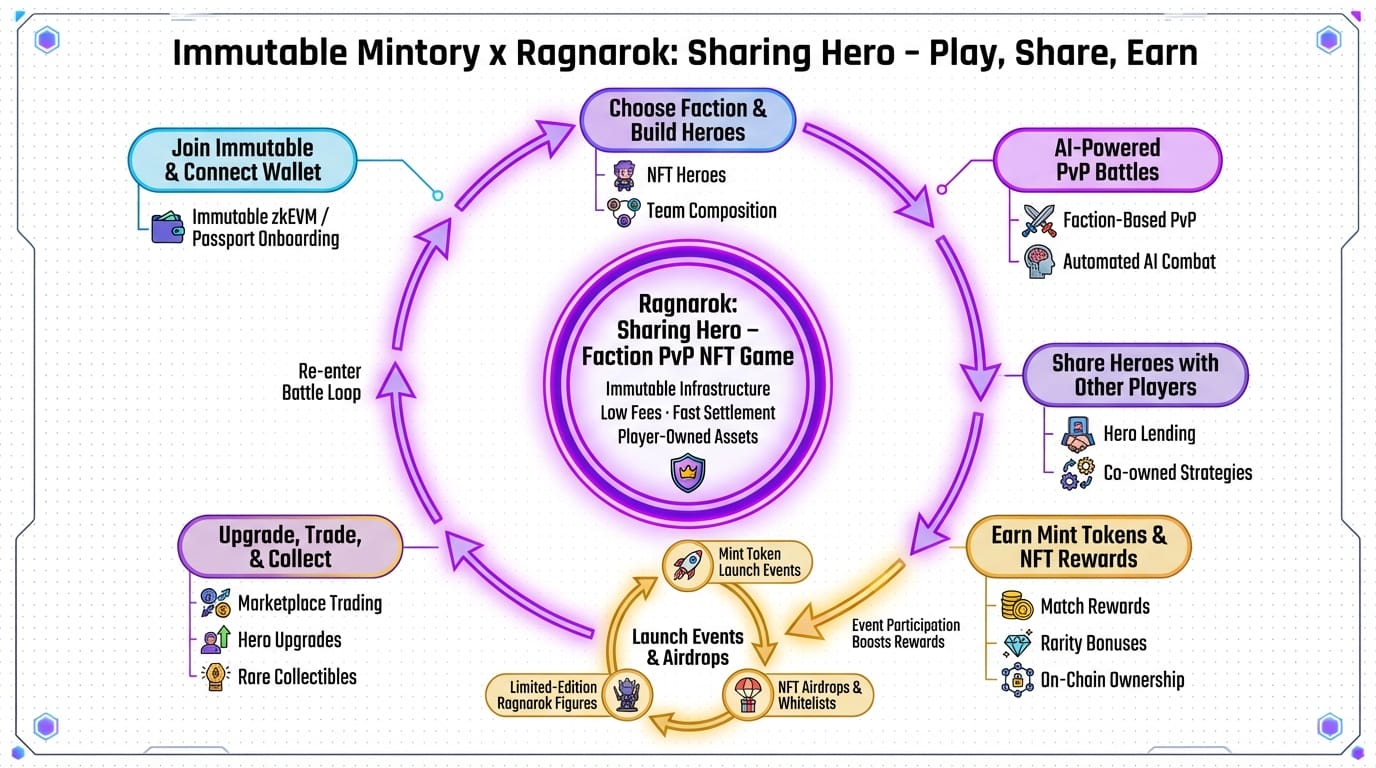
John (Analyst): Let’s cut through the hype. Ragnarok: Sharing Hero’s token is called MINT, used for in-game transactions, NFT minting, and governance. Emission comes from PvP rewards and launch events like airdrops, but sustainability hinges on token sinks—mechanisms that remove tokens from circulation, like burning fees for hero sharing or upgrading rares. Without strong sinks, we get inflation, where token value crashes as supply balloons. Based on initial docs from Immutable’s announcement, they’re aiming for balance via AI battle staking—think locking tokens to boost hero stats, reducing circulating supply. Long-term risks? If player adoption falters, low liquidity could lead to dumps. Check on-chain data via Etherscan or Immutable’s explorer for real emission rates; early indicators show moderate vesting schedules to prevent founder rugs.
Lila (Gamer): John, you’re such a buzzkill, but fair point. For players, this means your gameplay feeds into the economy—win PvP, earn MINT, use it to share heroes and multiply rewards.
Use Cases / Play Styles
Lila (Gamer): Here are three realistic ways to engage without expecting easy wins—outcomes vary based on skill and market vibes.
1. Active Battler: Dive into faction PvP, using AI for automated fights. Collect and upgrade NFT heroes, then compete for daily MINT rewards. It’s like grinding arenas in MMOs, but with blockchain ownership.
2. Passive Sharer: Own rare collectibles and lend them via the sharing mechanic. Earn a portion of battle earnings from borrowers—great for busy players who want low-effort involvement.
3. Community Builder: Join guilds or events for NFT airdrops. Focus on trading rares on secondary markets, building a portfolio while participating in limited-edition figure drops.
John (Analyst): Remember, these styles depend on network effects. Low player count means thin markets—always verify contract addresses on official sites to avoid scams.
| Feature | Traditional Web2 Game | Ragnarok: Sharing Hero (GameFi) |
|---|---|---|
| Ownership | No true ownership; items tied to account/server | NFT-based true ownership, transferable via blockchain |
| Progression | Grind for in-game currency, no real-world value | Earn MINT tokens through play, with potential secondary market value |
| Economy Design | Centralized, developer-controlled inflation | Decentralized with token sinks and sharing for balance |
Conclusion
John (Analyst): Ragnarok: Sharing Hero offers learning value in understanding shared economies—its design strengths lie in Immutable X integration for low-cost NFTs and potential sustainability through sinks like burning mechanisms. However, structural risks include inflation if adoption doesn’t scale, or volatility from airdrop hype. Outcomes depend entirely on player behavior, market conditions, and team execution—GameFi is high-risk, so start small and monitor on-chain metrics.
Lila (Gamer): It’s got that exciting PvP spark with sharing twists—worth watching if you’re into blockchain gaming, but always play responsibly!

👨💻 Author: SnowJon (GameFi / Web3 Researcher)
A researcher leveraging insights from the University of Tokyo Blockchain Innovation Program to analyze GameFi economies and Web3 adoption from a practical, evidence-first perspective.
The focus is translating complicated systems into frameworks readers can evaluate critically—fun factor, token sinks, inflation risk, and sustainability signals.
*AI may assist drafting, but final verification and responsibility rest with the human author.
References & Further Reading
- Immutable Introduces Mintory With New Ragnarok: Sharing Hero NFT Game | PlayToEarn
- Immutable Welcomes Ragnarok: Sharing Hero NFT to the Immutable Ecosystem
- Blockchain Gaming Weekly Roundup: 9th January – BlockchainGamerBiz
▼ AI tools to streamline research and content production (free tiers may be available)
Free AI search & fact-checking
👉 Genspark
Recommended use: Quickly verify key claims and track down primary sources before publishing
Ultra-fast slides & pitch decks (free trial may be available)
👉 Gamma
Recommended use: Turn your article outline into a clean slide deck for sharing and repurposing
Auto-convert trending articles into short-form videos (free trial may be available)
👉 Revid.ai
Recommended use: Generate short-video scripts and visuals from your headline/section structure
Faceless explainer video generation (free creation may be available)
👉 Nolang
Recommended use: Create narrated explainer videos from bullet points or simple diagrams
Full task automation (start from a free plan)
👉 Make.com
Recommended use: Automate your workflow from publishing → social posting → logging → next-task creation
※Links may include affiliate tracking, and free tiers/features can change; please check each official site for the latest details.