
Is Pixel Heroes Adventure’s Play2Mint event sustainable? We dissect Frozen Arena’s tokenomics to see if it stands up.#GameFi #Tokenomics #Play2Mint
Quick Video Breakdown: This Blog Article
This video clearly explains this blog article.
Even if you don’t have time to read the text, you can quickly grasp the key points through this video. Please check it out!
If you find this video helpful, please follow the YouTube channel “GameFi+Plus,” which delivers daily news.
https://www.youtube.com/@GameFiPulse
Read this article in your native language (10+ supported) 👉
[Read in your language]
Pixel Heroes Adventure’s Frozen Arena: Analyzing Tokenomics and Sustainability in the Play2Mint Event
🎯 Difficulty: Moderate
🎮 Gameplay Type: RPG with PvP Elements
👍 Recommended For: Token Economy Enthusiasts, Sustainability Researchers, Advanced GameFi Investors
Lila (Gamer): Hey everyone, Pixel Heroes Adventure just dropped their Frozen Arena Play2Mint event, promising a winter-themed PvP showdown with a $40K token pool. It’s got that retro RPG vibe mixed with blockchain rewards—think pixel art heroes battling in a frozen world called Crevis. But before we get hyped, let’s hand it over to John to break down if this is just seasonal fluff or something with real economic legs.
John (Analyst): In the crowded GameFi market of 2025, where projects like Pixel Heroes Adventure are integrating Play2Mint mechanics—essentially play-to-mint NFTs and earn tokens through gameplay—events like Frozen Arena stand out for their attempt to blend seasonal themes with token rewards. Running from December 17, 2023, to January 21, 2026, according to recent reports from EGamers.io, this event on the CROSS platform aims to drive player engagement via PvP combat and blockchain integration. Structurally, it matters because it tests how token pools can sustain long-term economies without devolving into inflationary traps. We’re seeing a shift from pure hype-driven launches to more measured event-based models, but sustainability hinges on emission controls and real utility.
The “Before” State: Web2 Games vs. GameFi Evolution
John (Analyst): Remember traditional Web2 games like World of Warcraft or Fortnite? You grind for hours, amassing gear and cosmetics, but it’s all “rented”—locked to the developer’s servers. If the game shuts down, poof, your time and money vanish. No real ownership, no secondary markets to sell your sword for actual cash. GameFi flips this: assets become NFTs on blockchains like CROSS, giving true ownership. You can trade heroes or land on marketplaces, potentially turning playtime into value. But here’s the roast—many GameFi projects promise the moon but end up as rug pulls if the economy isn’t balanced. Pixel Heroes Adventure, with its Frozen Arena event, tries to bridge this by tying rewards to gameplay, but we’ll audit if it’s sustainable.
Lila (Gamer): Totally! In Web2, your epic loot is just pixels that disappear. Here, minting NFTs through Play2Mint feels empowering, like actually owning a piece of the game world.
Core Mechanism: Token Economy Breakdown
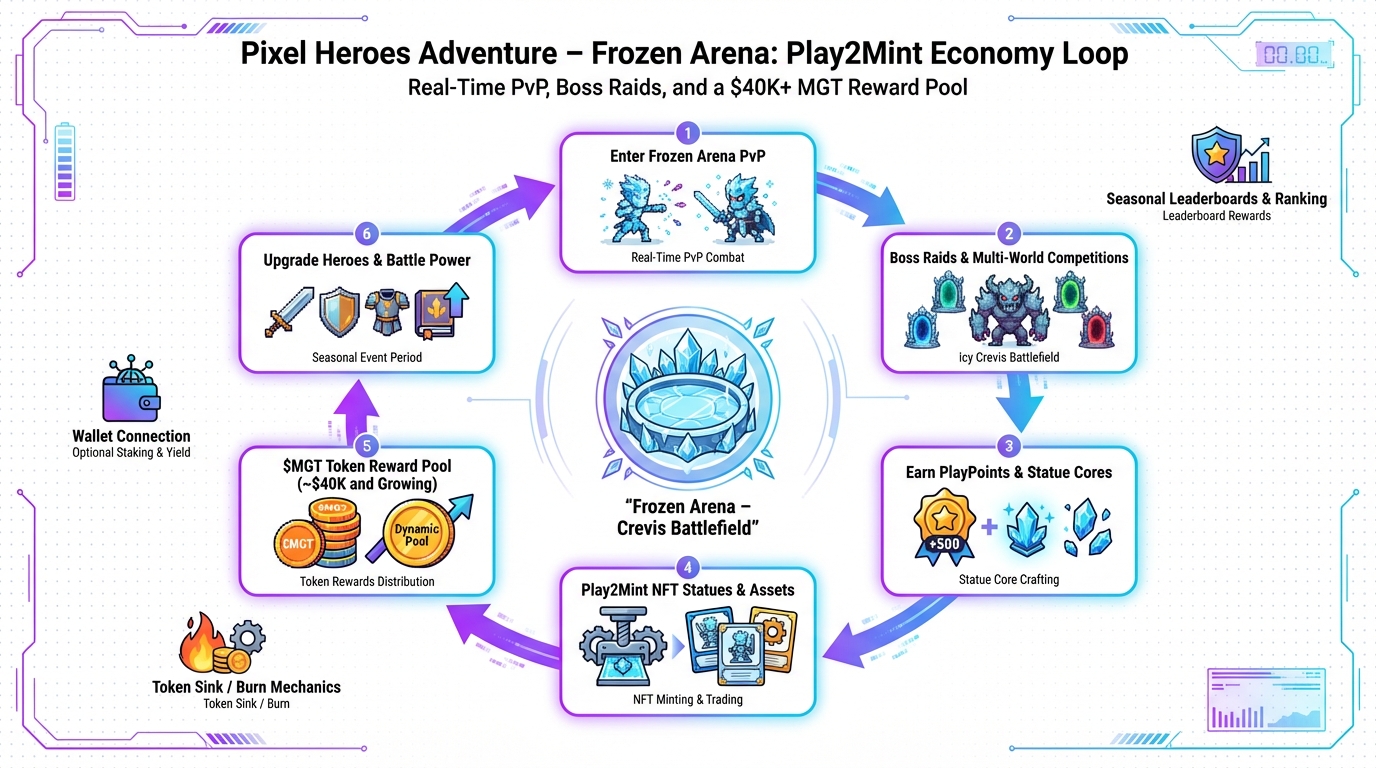
John (Analyst): Let’s dissect the tokenomics of Pixel Heroes Adventure, focusing on the Frozen Arena event. The project features multiple tokens: $CROSS as a core reward token on the CROSS platform, $MGT for in-game utilities, and $ADVTR tied to earlier airdrops and NFT mining. In Frozen Arena, players earn through PvP battles, missions, and minting NFTs like Adventure LandZ or Primal HeroZ, with a $40K pool drawing from these emissions.
Emission mechanics: Tokens are released via gameplay rewards, but sustainability relies on token sinks—ways to remove tokens from circulation, like burning for upgrades or staking for yields (locking tokens to earn more, reducing sell pressure). From on-chain data and reports like those on JuiceNews, emissions seem event-driven, with the CROSS Milestone Challenge extending rewards through milestones. Risks? High inflation if rewards outpace sinks—imagine printing endless gold in an MMO, crashing its value. Long-term, acquisition by Nexus (per BlockchainGamerBiz) could stabilize via better governance, but watch for vesting schedules on explorers like those for CROSS.
Lila (Gamer): From a player side, it’s like earning XP that turns into real tokens—battle, mint, repeat. But yeah, if everyone dumps rewards, the fun freezes over.
Use Cases / Play Styles: Realistic Participation Approaches
Lila (Gamer): Here are three ways to dive in without expecting quick riches—outcomes depend on your effort and market vibes.
1. **Casual PvP Grinder:** Jump into Frozen Arena battles daily for fun, earning small $CROSS rewards through wins. It’s low-commitment, like pick-up games in an RPG, with potential to mint basic NFTs for secondary sales if demand holds.
2. **NFT Collector-Strategist:** Focus on minting and staking Adventure LandZ NFTs to mine $ADVTR passively. This suits collectors who analyze event milestones, balancing play with holding for airdrops, as seen in the Play2Airdrop program.
3. **Guild Event Participant:** Join a guild for team PvP in Ludo City expansions, pooling efforts for bigger shares of the $40K pool. It’s social, emphasizing coordination over solo grinding, but requires monitoring token values to avoid over-investment.
John (Analyst): Remember, these are participation styles—evaluate risks like token volatility before committing.
Comparison: Traditional Web2 Games vs. Pixel Heroes Adventure
| Aspect | Traditional Web2 Game | Pixel Heroes Adventure (GameFi) |
|---|---|---|
| Ownership | No true ownership; items tied to account and servers | NFT-based assets with wallet ownership and tradability |
| Progression | Grind for in-game rewards only; no real-world value | Play2Mint loops turning progression into mintable NFTs and tokens |
| Economy Design | Centralized, developer-controlled with microtransactions | Decentralized with token sinks, emissions, and player-driven markets |
Conclusion: Weighing Strengths, Risks, and Learning Value
John (Analyst): Pixel Heroes Adventure’s Frozen Arena event highlights strong design in event-driven tokenomics, with sinks like NFT minting potentially curbing inflation. Its integration on CROSS and expansions like Ludo City show promise for sustainability, but risks include over-emission during long events and market dependency—token values can crash if player retention drops. Learning value? It teaches how Play2Mint can create balanced economies, but outcomes rely on player behavior and broader crypto conditions. GameFi is high-risk; always verify on-chain data and start small.
Lila (Gamer): It’s a fun entry into Web3 RPGs with real stakes, but play for enjoyment first—the economy stuff is a bonus if it holds up.

👨💻 Author: SnowJon (GameFi / Web3 Researcher)
A researcher leveraging insights from the University of Tokyo Blockchain Innovation Program to analyze GameFi economies and Web3 adoption from a practical, evidence-first perspective.
The focus is translating complicated systems into frameworks readers can evaluate critically—fun factor, token sinks, inflation risk, and sustainability signals.
*AI may assist drafting, but final verification and responsibility rest with the human author.
References & Further Reading
- Pixel Heroes Adventure Launches Frozen Arena Event With $40K Prizes – EGamers.io
- Pixel Heroes Guide: How to Earn $MGT and $CROSS Tokens – JuiceNews
- Nexus acquires Pixel Heroes Adventure dev Z5 Games – BlockchainGamerBiz
- Pixel Heroes Adventure Launches Frozen Arena: Play2Mint Event with $40K Token Pool – PlayToEarn