
Personally Parallel Studios seems focused on building balanced digital economies.#GameFi #Web3Gaming
Quick Video Breakdown: This Blog Article
This video clearly explains this blog article.
Even if you don’t have time to read the text, you can quickly grasp the key points through this video. Please check it out!
If you find this video helpful, please follow the YouTube channel “GameFi+Plus,” which delivers daily news.
https://www.youtube.com/@GameFiPulse
Read this article in your native language (10+ supported) 👉
[Read in your language]
Dissecting Parallel Studios’ GameFi Ecosystem: Tokenomics and Sustainability in the 2026 Mobile TCG Launch
🎮 Gameplay Type: Card (TCG with Strategy Elements)
👍 Recommended For: Tokenomics Analysts, Long-term Investors in Web3 Gaming, Experienced P2E Strategists
In the evolving landscape of GameFi, where blockchain meets gaming, Parallel Studios stands out with its ambitious Q1 2026 rollouts. Drawing from market trends post-2024 crypto winters, projects like this emphasize integrated economies blending NFTs, DeFi, and AI. Parallel’s mobile TCG launch, alongside Parallel Colony and AI Wayfinder, matters structurally because it attempts to fuse traditional TCG mechanics with sustainable token flows—potentially avoiding the hyper-inflation pitfalls seen in early P2E models. This analysis breaks down the design philosophy, focusing on economic balance rather than surface-level hype.
The “Before” State: Web2 Gaming vs. GameFi Realities
Traditional Web2 games, like classic mobile TCGs such as Hearthstone, lock players into centralized ecosystems. You grind for cards, but ownership is illusory—servers shut down, and your collection vanishes. Costs are sunk; progression feels like a treadmill with no off-ramp. Enter GameFi: Parallel introduces true NFT ownership, where cards exist on the blockchain (likely Ethereum-compatible layers), tradable on secondary markets. This shifts from “pay to play” to “play to own,” but it introduces volatility—token values can crash if emission rates outpace sinks.
Core Mechanism: Token Economy Breakdown
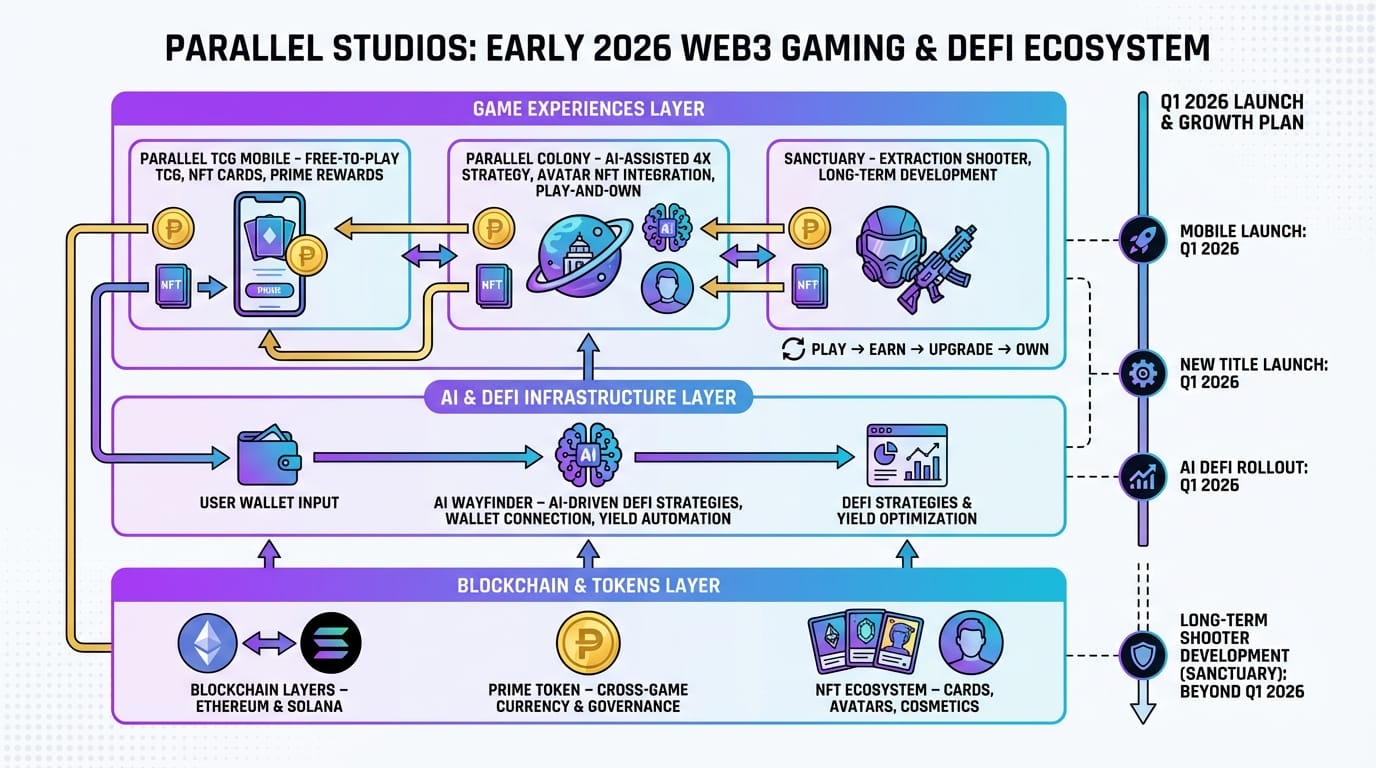
Lila (Gamer): Okay, let’s keep it real—Parallel’s TCG isn’t just about slinging cards; it’s got this blockchain layer that lets you earn while battling. But John, break down the economy without the fluff.
John (Analyst): Straight to the point. Parallel operates on a dual-token system, inferred from their DeFi integrations (check their official docs for PRIME token details via Parallel’s whitepaper). Emission comes from gameplay rewards—win matches, earn tokens—but sustainability hinges on token sinks like card upgrades or staking for governance. Without audited sinks (e.g., burning mechanisms via Chainlink oracles for fairness), we risk inflation overwhelming supply. On-chain data from explorers like Etherscan could reveal vesting schedules; watch for large unlocks in Q1 2026 that might dilute value. Risks include over-emission if player growth stalls, turning it into another Axie-like fade.
Use Cases / Play Styles
Lila (Gamer): For players diving in, here are three ways to engage without expecting moonshots.
1. Competitive Battler: Focus on ranked matches in the mobile TCG, building decks with NFTs. Earnings depend on win rates and market demand for rare cards—treat it like grinding ladder in any TCG, but with potential resale value.
2. Ecosystem Participant: Use Parallel Colony’s 4X strategy mode to farm resources, feeding into the broader token pool. This suits those who enjoy long-form progression, where AI assists in decision-making, but output varies with community activity.
3. DeFi Integrator: Leverage AI Wayfinder for staking or liquidity provision—add tokens to pools (pots of money for instant trades) to earn yields. It’s for those monitoring APRs, but remember, impermanent loss can erode holdings if prices swing.
John (Analyst): Solid styles, but always verify contract addresses on official channels to avoid scams. Outcomes tie to market conditions, not guarantees.
Comparison: Traditional Web2 Game vs. This GameFi Project
| Aspect | Traditional Web2 Game (e.g., Mobile TCG) | Parallel Studios GameFi Project |
|---|---|---|
| Ownership | No true ownership; items tied to account and servers | NFT-based ownership; tradeable on open markets |
| Progression | Grind for in-game currency; no real-world value | Earn tokens/NFTs with potential economic utility |
| Economy Design | Centralized, developer-controlled inflation | Decentralized with sinks and emissions; risks of volatility |
| Long-term Risks | Game shutdown leads to total loss | Token devaluation or rug pulls if sinks fail |
Conclusion
Lila (Gamer): Parallel’s blend of TCG fun with AI and DeFi could make for engaging sessions, especially on mobile—it’s worth exploring for the strategic depth.
John (Analyst): Structurally, the project’s strength lies in its multi-title ecosystem, potentially creating cross-token utility to combat inflation. Learning value comes from understanding balanced economies, but risks include adoption shortfalls and external market crashes. Remember, GameFi is high-risk; outcomes depend on player behavior, token design execution, and broader crypto conditions. Start small, audit on-chain metrics via tools like Dune Analytics, and evaluate sustainability signals like active wallets post-launch.
Risk Disclaimer: This is not financial advice; GameFi involves significant volatility and potential losses.

👨💻 Author: SnowJon (Web3 & AI Practitioner / Researcher)
A researcher leveraging insights from the University of Tokyo Blockchain Innovation Program to analyze GameFi, Web3, and digital economies from a practical and structural perspective.
His focus is on translating complex systems into frameworks that readers can evaluate and think about critically.
*AI may assist with drafting, but final verification and responsibility rest with the human author.
References & Further Reading
- Parallel Studios Confirms Mobile TCG Launch and Multiple Q1 Rollouts in 2026 | PlayToEarn
- Parallel Prepares Major Releases for Early 2026 | GAM3S.GG
- Parallel Studios Unveils Mobile TCG And Multiple Early 2026 Releases – EGamers.io
- Parallel Studios Official Website (For Whitepaper and Docs)
▼ AI tools to streamline research and content production (free tiers may be available)
Free AI search & fact-checking
👉 Genspark
Recommended use: Quickly verify key claims and track down primary sources before publishing
Ultra-fast slides & pitch decks (free trial may be available)
👉 Gamma
Recommended use: Turn your article outline into a clean slide deck for sharing and repurposing
Auto-convert trending articles into short-form videos (free trial may be available)
👉 Revid.ai
Recommended use: Generate short-video scripts and visuals from your headline/section structure
Faceless explainer video generation (free creation may be available)
👉 Nolang
Recommended use: Create narrated explainer videos from bullet points or simple diagrams
Full task automation (start from a free plan)
👉 Make.com
Recommended use: Automate your workflow from publishing → social posting → logging → next-task creation
※Links may include affiliate tracking, and free tiers/features can change; please check each official site for the latest details.