Read this article in your native language (10+ supported) 👉
[Read in your language]
Heroes of Mavia’s Limited-Edition NFTs: Turning Player Skill into On-Chain Collectibles
🎯 Difficulty: Moderate
🎮 Gameplay Type: Strategy
👍 Recommended For: Casual mobile gamers seeking quick sessions, strategy enthusiasts who enjoy base-building, and NFT collectors interested in skill-based rewards
Lila: “Wow, limited-edition NFTs based on real player activity? That sounds like every match you win turns into a rare collectible you can flex and sell – instant millionaire vibes from grinding!”
John: “Hype aside, Lila, most ‘player activity’ NFTs are just reskinned pay-to-win cosmetics with zero scarcity if emissions outpace demand. Reality: These are skill-gated drops rewarding top performers, but value hinges on secondary market liquidity, not your K/D ratio alone. Ownership is real, but sustainability depends on balanced sinks like Ruby burns and tournament fees.“
Heroes of Mavia, a free-to-play mobile strategy game by Skrice Studios, bridges Web2 gaming polish with Web3 ownership through its “Mass Ownership” model. The recent introduction of limited-edition NFTs tied to real player activity elevates this by minting unique on-chain items – like hero skins, statues, and land upgrades – earned via Ruby, a skill-based reward currency. This matters structurally because it creates genuine player-driven scarcity: only top attackers, defenders, and challenge-completers craft these, feeding a gas-free in-game marketplace without flooding supply.[1][2]
In traditional Web2 games like Clash of Clans clones, your hours of grinding evaporate if servers shut down – progress is rented, assets non-transferable. GameFi flips this: Mavia’s NFTs are wallet-owned, tradable on Ruby Marketplace or secondary markets, with Ruby earned (not bought) ensuring merit-based entry. This reduces pump-and-dump risks by tying rewards to performance, not faucets.[1]
Core Mechanism: How It Works
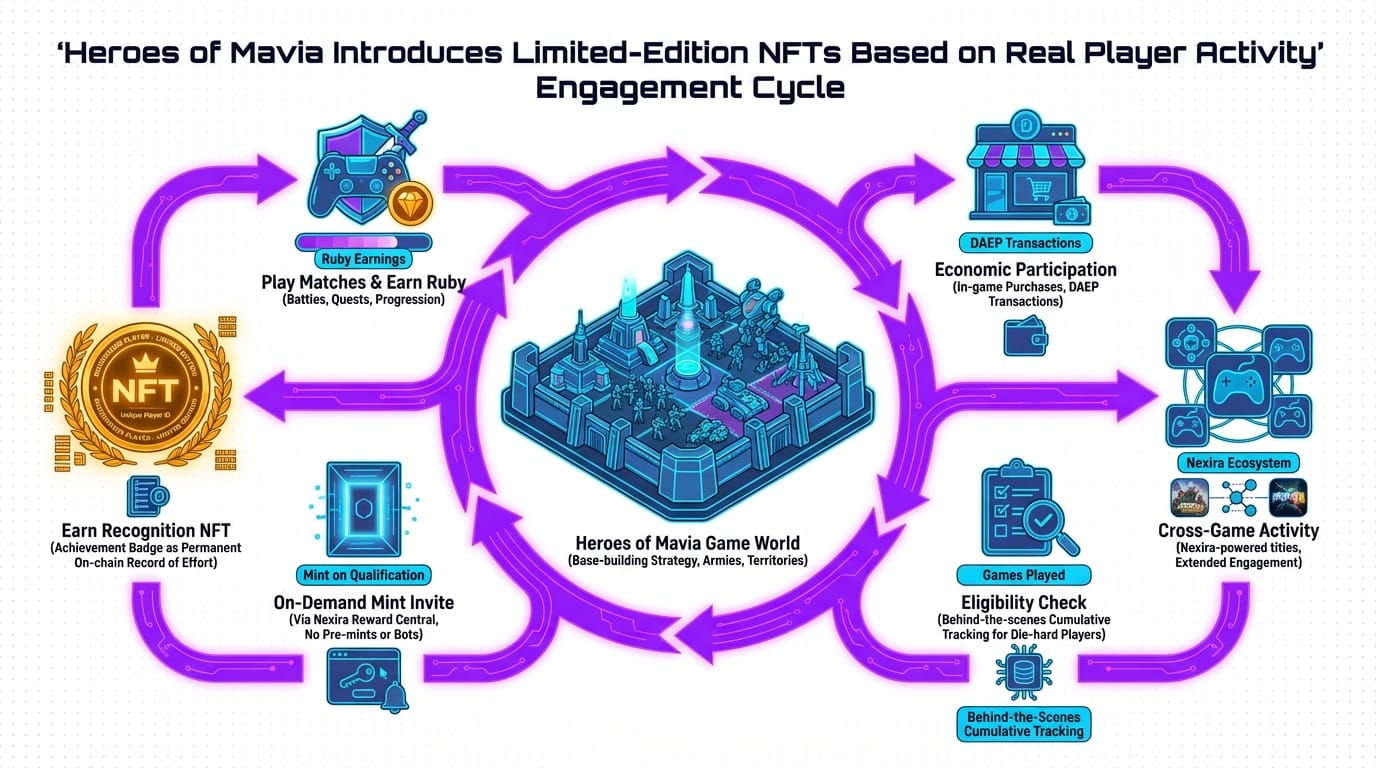
Focus on the central Ruby flow: emissions from attacks/defenses feed crafting/upgrades, with marketplace fees (2% burn in modes like Ruby Battles) acting as sinks to curb inflation. MAVIA governs this externally via DAO votes on rules.[1]
Players build bases with Gold/Oil, train troops (infantry, vehicles, aerial), attack/defend for Ruby. Ruby crafts Legendary Items (NFTs), which boost performance. Limited-edition variants drop for elite activity, like top leaderboard defenses, creating rarity. MAVIA powers Arena wagers and governance; Sapphire speeds timers via IAP. Emissions: 10% token allocation to rewards (6-year vest). Sinks: burns, fees, upgrades. Risk: if player growth stalls, Ruby devalues NFTs.[1][2]
Fun Factor Scorecard
From Lila’s view: “It’s got that addictive ‘one more attack’ pull without feeling like a second job.”
- Session loop: Perfect for 10-20 min bursts – quick base tweaks, troop trains, one raid. Upgrades run in background.
- Replayability/variety: Dozens of units/heroes with counters (e.g., anti-air vs. aerial), alliances, events, NFT customization.
- UX friction: Built-in wallet, gas-free trades, App Store download – minimal blockchain hassle, though bridging for secondary sales adds a step.
Use Cases / Play Styles
- Low-risk/low-commitment (Free Grinder): Download free, earn Ruby via daily attacks/defenses without NFTs. Spectate alliances or join public ones for shared rewards – pure fun, no wallet needed initially.
- Mid-tier Builder: Invest Sapphire for speed-ups, craft basic NFTs with earned Ruby, trade in marketplace for incremental edges. Focus: steady base progression, occasional PvP.
- Elite Competitor: Grind for limited-edition NFTs via top activity (e.g., leaderboard wins), enter MAVIA Arena wagers, DAO vote on meta changes. High skill ceiling with alliance wars looming.
Beginner Traps & Safety Notes
- Verify official site (mavia.com) and Discord – phishing clones mimic with “free Ruby” airdrops leading to wallet drains.
- Never approve unlimited signatures; use built-in wallet for in-game, external only for verified trades. Revoke via explorers like Etherscan.
- Hidden costs: Gas for external NFT sales (Ethereum/Arbitrum), bridging to BNB, Sapphire IAP if impatient – budget 5-10% extra.
- Avoid overpaying early NFTs; limited-editions are earnable via skill, not just mint rushes – check Ruby Marketplace floors first.
- Always paste contract addresses (e.g., MAVIA: 0x24fcfc492c1393274b6bcd568ac9e225bec93584) into Etherscan/BscScan for verification before interacting.[1]
Signals Checklist: Red / Yellow / Blue
Red Flags (Stop-and-check):
- Ruby emissions spike without matching sink utilization (e.g., low burn fees vs. high rewards).
- Team unlocks (22% allocation) dump without DAO transparency post-6-month cliff.
- Declining active users despite events – signals circular rewards over external demand.
Yellow Flags (Monitor):
- Insider allocations (pre-sale 15%) trading heavily pre-utility ramps like Alliance Wars.
- Treasury runway shortening if Nexira DAEP delays impact multi-game interoperability.
- Governance permissions overly centralized pre-DAO maturity.
Blue Flags (Positive signals):
- Audits on core contracts (Ruby Marketplace, NFT mints) with no critical vulns.
- Steady secondary volume on limited NFTs > primary emissions.
- Player growth via mobile metrics (e.g., App Store ranks) tying to Ruby burns.
| Feature | Traditional Game (Web2) | This GameFi Project (Web3) |
|---|---|---|
| Ownership | Rented (Server shut down = Loss) | Wallet-based assets (NFTs / tokens) |
| Progression | Grind-locked, IAP paywalls | Skill-earned Ruby → NFTs, tradable |
| Economy Design | Infinite supply, no player take | Ruby sinks (burns/fees), MAVIA governance |
| Player Risk | Time sink, no liquidity | Market vol, but portable assets |
| Sustainability Signals | Publisher profits only | Long vests (6-yr), DAO control |
Scenario Lens: If-Then Outcomes (No Price Calls)
- Best-case: External demand grows (mobile virality + Alliance Wars) AND sinks scale (high Ruby burns). Watch: active users >1M, marketplace volume > emissions, treasury >2yrs runway.
- Base-case: Demand flat (steady App rankings) AND emissions continue vested. Watch: unlock calendar vs. sink utilization, DAO proposal activity, secondary NFT floors.
- Worst-case: Unlocks spike OR rewards dominate (low skill threshold). Watch: player churn rates, Ruby inflation metrics, competition from new P2E titles.
Two-Track Verdict: Player vs Economy
Player Verdict (Lila): Solid fun for strategy fans – buttery 60FPS mobile, quick loops, alliance teamwork without heavy grind. Best for casual raiders to competitive leaderboard chasers; UX shines with gasless trades.
Economy Verdict (John): Balanced multi-currency design with skill gates and DAO oversight; biggest risk is adoption-dependent sinks failing if Web2 onboarding plateaus. Key data: Ruby velocity, NFT rarity metrics, vesting adherence.
If one track fails, the whole loop breaks.
Heroes of Mavia’s limited-edition NFTs exemplify smart GameFi design: skill-to-ownership conversion with mobile accessibility and sustainable tokenomics via Ruby/MAVIA separation. Strengths include gas-free UX and long vests signaling alignment; risks center on execution amid competition. Outcomes hinge on player retention and market dynamics. Next step: Review the token unlock schedule on mavia.com and verify NFT contracts on-chain.
References & Further Reading
- Heroes of Mavia Introduces Limited-Edition NFTs Based on Real Player Activity
- What Is MAVIA Crypto – Future of Web3 Gaming
- Mavia Whitepaper
▼ AI tools to streamline research and content production (free tiers may be available)
Free AI search & fact-checking
👉 Genspark
Recommended use: Quickly verify key claims and track down primary sources before publishing
Ultra-fast slides & pitch decks (free trial may be available)
👉 Gamma
Recommended use: Turn your article outline into a clean slide deck for sharing and repurposing
Auto-convert trending articles into short-form videos (free trial may be available)
👉 Revid.ai
Recommended use: Generate short-video scripts and visuals from your headline/section structure
Faceless explainer video generation (free creation may be available)
👉 Nolang
Recommended use: Create narrated explainer videos from bullet points or simple diagrams
Full task automation (start from a free plan)
👉 Make.com
Recommended use: Automate your workflow from publishing → social posting → logging → next-task creation
※Links may include affiliate tracking, and free tiers/features can change; please check each official site for the latest details.