From experience, GIGA SWAP highlights the need for sustainable sinks in digital economies.#GameFi #Web3
Quick Video Breakdown: This Blog Article
This video clearly explains this blog article.
Even if you don’t have time to read the text, you can quickly grasp the key points through this video. Please check it out!
If you find this video helpful, please follow the YouTube channel “GameFi+Plus,” which delivers daily news.
https://www.youtube.com/@GameFiPulse
Read this article in your native language (10+ supported) 👉
[Read in your language]
Gigaverse’s GIGA SWAP: Analyzing Tokenomics and Economic Sustainability in GameFi Redemption
🎮 Gameplay Type: Play-to-Earn (P2E) with Strategy Elements
👍 Recommended For: Tokenomics Analysts, Web3 Researchers, Long-term GameFi Investors
In the evolving landscape of GameFi, where blockchain integrates with gaming to create playable economies, Gigaverse’s launch of GIGA SWAP represents a structural shift toward bridging in-game assets with real-world value. Announced on January 14, 2026, this feature allows players to redeem in-game USD items directly for USDC, a stablecoin pegged to the U.S. dollar. Drawing from broader market trends—like the resurgence in projects such as Axie Infinity amid tokenomics updates—this development matters because it addresses a core challenge in GameFi: converting virtual earnings into tangible liquidity without excessive friction. As a researcher examining sustainable digital economies, I’ll dissect how GIGA SWAP fits into Gigaverse’s overall design philosophy, emphasizing economic balance over speculative hype.
John (Analyst): Let’s cut through the noise. GameFi projects often tout “earn while you play,” but many are just inflationary token farms disguised as games. Gigaverse’s GIGA SWAP isn’t promising moonshots—it’s building infrastructure for redemptions, which could signal a focus on sustainability if the tokenomics hold up. We’ll audit that.
Lila (Gamer): From a player’s view, it’s exciting to see real USDC payouts, especially with over $22,000 available from recent competitions. But John, you’re right—it’s not just about the fun; the economy has to last beyond the initial buzz.
Before diving deeper, consider the “before” state of gaming. In traditional Web2 games, like Fortnite or League of Legends, players invest time and money into cosmetics, upgrades, or in-game currencies that remain locked within the ecosystem. If the servers shut down or the company pivots, those assets vanish—pure sunk cost with no ownership transfer. GameFi flips this script: through NFTs and blockchain, players gain true ownership. You can sell or trade assets on secondary markets, potentially recouping value. However, this introduces economic risks, such as token inflation from unchecked emissions, which Gigaverse aims to mitigate with structured redemptions like GIGA SWAP.
Core Mechanism: Tokenomics and Economy Design
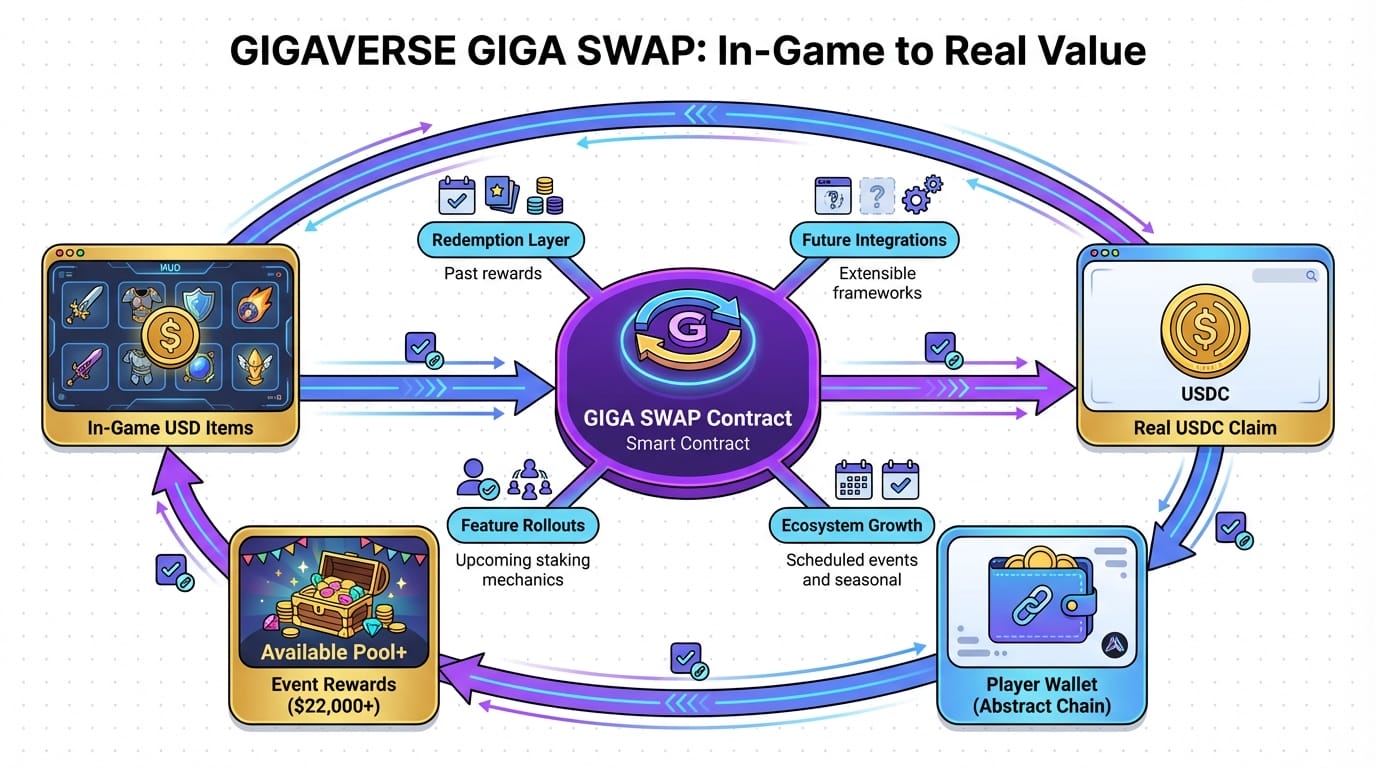
Gigaverse’s tokenomics revolve around the GIGA token, integrated with in-game mechanics that generate USD items redeemable via GIGA SWAP for USDC. Think of it like earning “gold” in a traditional RPG, but here, that gold can be swapped for real stablecoins. The emission model appears controlled—tokens are distributed through gameplay rewards, competitions, and events, with redemptions acting as a token sink to remove circulating supply. This is crucial for sustainability: without sinks (mechanisms that burn or lock tokens), inflation can spiral, devaluing earnings as seen in early GameFi busts like some 2021 projects.
John (Analyst): Auditing the numbers: Based on on-chain data from sources like Abstract wallets (as mentioned in project updates), over $22,000 in USDC has been claimed post-launch. This ties into a broader economy where GIGA tokens facilitate swaps. Risks include over-emission if player influx outpaces sinks—imagine a game where everyone farms rewards faster than they spend or burn them, leading to a price crash. Gigaverse counters this with event-based rollouts, but long-term, we’ll need to monitor unlock schedules via explorers like Etherscan or Solana‘s if applicable. No audits mentioned yet, so verify contract addresses before engaging.
Lila (Gamer): On the gameplay side, it’s like upgrading your character in an MMO, but with real stakes. You play, earn USD items, and swap them out—simple loop, but the economy design ensures it’s not just grind-to-zero.
The balance hinges on dual-token systems: in-game USD items (non-tokenized assets) convert to USDC, while GIGA likely handles governance or utility. This hybrid avoids pure speculation, but risks remain if redemptions flood the market with sell pressure. Compared to projects like Axie Infinity, which recently surged 60% after tokenomics tweaks (reducing inflation), Gigaverse’s model promotes retention through actual utility.
Use Cases / Play Styles
Gigaverse supports varied participation styles, each leveraging GIGA SWAP differently. Outcomes depend on market dynamics and personal strategy—there’s no one-size-fits-all path.
1. Competitive Player: Focus on tournaments to accumulate high-value USD items. Redeem via GIGA SWAP for USDC, then reinvest in-game or withdraw. This suits those who treat it like esports, but watch for competition dilution if too many players join, reducing per-player rewards.
2. Passive Accumulator: Engage in idle or low-effort activities to build USD items over time. Use GIGA SWAP for periodic redemptions, treating it as a side hustle. Sustainability here relies on the project’s ability to maintain token value without constant hype.
3. Ecosystem Builder: Hold GIGA tokens for governance or staking (if available—check official docs), while using swaps to liquidity manage. This advanced style involves monitoring on-chain metrics for risks like impermanent loss in any liquidity pools, emphasizing long-term ecosystem health over quick flips.
John (Analyst): Remember, these are frameworks—evaluate the data yourself. GameFi is high-risk; start small and understand the volatility.
Comparison: Traditional Web2 Game vs. Gigaverse GameFi
| Aspect | Traditional Web2 Game | Gigaverse GameFi |
|---|---|---|
| Ownership | Virtual items are licensed, not owned; lost on shutdown. | True ownership via NFTs or wallet-held assets; tradable on secondary markets. |
| Progression | Grind for non-transferable rewards; progression resets possible. | Earn redeemable items; progression tied to economic loops with real value potential. |
| Economy Design | Centralized, controlled by devs; no player-driven markets. | Decentralized with token sinks and emissions; risks of inflation but potential for sustainability. |
This table highlights Gigaverse’s edge in ownership, but Web2’s stability avoids crypto volatility.
Conclusion
Gigaverse’s GIGA SWAP offers learning value in how GameFi can integrate real-world redemptions without over-relying on hype. Strengths include its focus on utility-driven tokenomics, with sinks like USDC swaps potentially curbing inflation. However, structural risks—such as dependency on player retention, external market crashes, or unaddressed emission imbalances—could undermine longevity. Outcomes hinge on individual behavior, broader adoption, and economic conditions; always approach with caution, verifying on-chain data. GameFi remains high-risk, so prioritize understanding over speculation.

👨💻 Author: SnowJon (Web3 & AI Practitioner / Researcher)
A researcher leveraging insights from the University of Tokyo Blockchain Innovation Program to analyze GameFi, Web3, and digital economies from a practical and structural perspective.
His focus is on translating complex systems into frameworks that readers can evaluate and think about critically.
*AI may assist with drafting, but final verification and responsibility rest with the human author.
References & Further Reading
- Gigaverse Launches GIGA SWAP, Letting Players Redeem In-Game USD Items for Real USDC | PlayToEarn
- Gigaverse Launches GIGA SWAP – EGamers.io
- Axie Infinity (AXS) Jumps 60%, Breaks $2—Is GameFi Finally Waking Up? – Coinpedia
- What is Tokenomics? Models, Examples. Games Economy Overview – Blaize
▼ AI tools to streamline research and content production (free tiers may be available)
Free AI search & fact-checking
👉 Genspark
Recommended use: Quickly verify key claims and track down primary sources before publishing
Ultra-fast slides & pitch decks (free trial may be available)
👉 Gamma
Recommended use: Turn your article outline into a clean slide deck for sharing and repurposing
Auto-convert trending articles into short-form videos (free trial may be available)
👉 Revid.ai
Recommended use: Generate short-video scripts and visuals from your headline/section structure
Faceless explainer video generation (free creation may be available)
👉 Nolang
Recommended use: Create narrated explainer videos from bullet points or simple diagrams
Full task automation (start from a free plan)
👉 Make.com
Recommended use: Automate your workflow from publishing → social posting → logging → next-task creation
※Links may include affiliate tracking, and free tiers/features can change; please check each official site for the latest details.