
Personally Corners on Base shifts focus from gameplay loops to sustainable digital ownership.#GameFi #Web3
Quick Video Breakdown: This Blog Article
This video clearly explains this blog article.
Even if you don’t have time to read the text, you can quickly grasp the key points through this video. Please check it out!
If you find this video helpful, please follow the YouTube channel “GameFi+Plus,” which delivers daily news.
https://www.youtube.com/@GameFiPulse
Read this article in your native language (10+ supported) 👉
[Read in your language]
Corners on Base: Analyzing the Tokenomics of Onchain Curation in The Sandbox Ecosystem
🎮 Gameplay Type: Curation and Trading (Onchain Collection Building)
👍 Recommended For: Blockchain researchers, NFT economy analysts, Web3 content curators
Lila (Gamer): Hey everyone, Lila here. As a guild manager who’s always scouting for fresh Web3 experiences, Corners caught my eye with its launch on Base, backed by The Sandbox. It’s not your typical grind-and-earn game—it’s more about curating internet content into tradeable collections. But let’s not get carried away; John, what’s the structural angle here? Why does this matter in the broader GameFi market?
John (Analyst): Lila, spot on. In a market flooded with fleeting P2E hype, Corners represents a shift toward sustainable onchain utilities. Built on Coinbase’s Base Layer-2 network and integrated with The Sandbox’s SAND token, it aims to extend the ecosystem’s reach by enabling users to “coin” and trade curated content collections. This isn’t just another metaverse add-on; it’s a bet on creator economies where curation becomes a tokenized activity. From a design philosophy standpoint, it addresses the fatigue in traditional GameFi by focusing on cultural and content layers rather than pure gameplay loops. But sustainability hinges on how well it balances token flows—let’s dissect that objectively.
The “Before” State: From Web2 Gatekeeping to GameFi Ownership
Lila (Gamer): Remember the old days of Web2 games? You’d pour hours into collecting items or building profiles, only for the devs to shut down servers or reset everything. No real ownership, just sunk costs and frustration.
John (Analyst): Exactly. In traditional Web2 platforms like Pinterest or Reddit collections, users curate content without economic upside—it’s all centralized, with no secondary markets for your efforts. GameFi flips this: through NFTs and blockchain, you get true ownership. Sell your curated “Corner Coins” on open markets, and the value persists beyond the platform. Corners builds on this by tying into The Sandbox’s ecosystem, where SAND powers transactions. But beware, this ownership comes with volatility—NFT values can crash if the ecosystem falters.
Core Mechanism: Token Economy Design
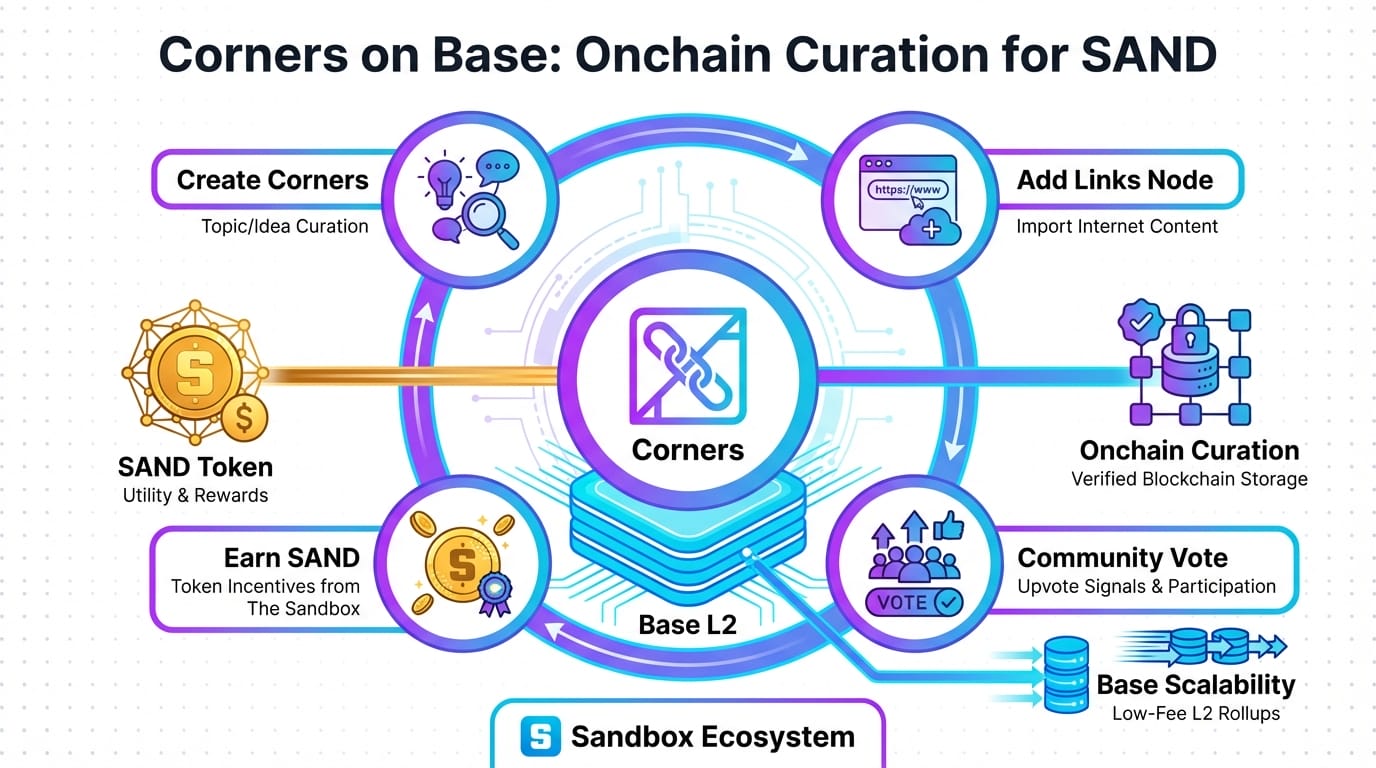
Lila (Gamer): Okay, John, break it down for us. How does the economy actually work in Corners?
John (Analyst): At its core, Corners uses SAND as the utility token on Base, incentivizing curation. Users create “Corner Coins” by collecting and minting internet links into NFTs—think of it like building a themed portfolio of content. Tokenomics revolve around emission and sinks: New SAND enters via rewards for active curation (emission), but sinks like transaction fees and staking requirements burn or lock tokens to control inflation. Based on Messari’s report on The Sandbox ecosystem, SAND’s total supply is capped, with Base integration streamlining onboarding to reduce gas costs (transaction fees on blockchain). Sustainability comes from balancing these—too much emission leads to devaluation, as we’ve seen in early P2E models. Long-term risks include low adoption driving token velocity too high, where tokens circulate without value accrual. Check on-chain data via explorers like Basescan for real emission rates; as of early 2026, SAND’s integration shows promising liquidity, but external market conditions could amplify risks.
Use Cases / Play Styles
Lila (Gamer): For players jumping in, here are three realistic ways to engage—remember, outcomes vary based on effort and timing.
John (Analyst): First, the “Curator Builder”: Focus on niche themes like Web3 news or meme collections, minting Corner Coins and holding for community growth. This style suits researchers tracking trends, with potential value from scarcity if your curation gains traction.
Lila (Gamer): Second, the “Trader Speculator”: Buy and sell existing Corner Coins on secondary markets, leveraging SAND for quick flips. It’s high-risk, like day-trading skins in CS:GO but with blockchain permanence—watch for market sentiment shifts.
John (Analyst): Third, the “Ecosystem Integrator”: Use Corners within The Sandbox metaverse, linking curated content to virtual lands or experiences. This appeals to advanced users building cross-platform value, but it requires monitoring SAND’s unlock schedules to avoid dilution risks.
Comparison: Traditional Web2 vs. Corners in GameFi
| Aspect | Traditional Web2 Game/Platform | Corners (GameFi Project) |
|---|---|---|
| Ownership | No true ownership; content locked to platform, deletable by admins. | NFT-based ownership of curated collections, transferable via wallet. |
| Progression | Linear, dev-controlled unlocks with no economic exit. | Dynamic, community-driven via curation and trading, with SAND incentives. |
| Economy Design | Centralized monetization (ads, subs) without user share. | Decentralized with token sinks and emissions, tied to Base for efficiency. |
Conclusion: Weighing Strengths and Risks
Lila (Gamer): Corners offers solid learning value for anyone curious about onchain curation—it’s a fresh take on blending content with blockchain.
John (Analyst): Structurally, its strengths lie in SAND integration and Base’s low-cost scaling, potentially fostering long-term sustainability through real utility. However, risks include hyperinflation if curation rewards outpace sinks, or adoption failure leading to illiquidity. Outcomes depend entirely on player behavior, market conditions, and ecosystem health—always verify on-chain metrics and start small. GameFi is high-risk; evaluate the data yourself.

👨💻 Author: SnowJon (Web3 & AI Practitioner / Researcher)
A researcher leveraging insights from the University of Tokyo Blockchain Innovation Program to analyze GameFi, Web3, and digital economies from a practical and structural perspective.
His focus is on translating complex systems into frameworks that readers can evaluate and think about critically.
*AI may assist with drafting, but final verification and responsibility rest with the human author.
References & Further Reading
- Corners Goes Live on Base With The Sandbox Support
- Corners Debuts On Base, Enhancing SAND Ecosystem With Onchain Curation – EGamers.io
- The Future of The Sandbox Ecosystem | Messari
- The Sandbox Collaborates With Base To Expand $SAND Availability
▼ AI tools to streamline research and content production (free tiers may be available)
Free AI search & fact-checking
👉 Genspark
Recommended use: Quickly verify key claims and track down primary sources before publishing
Ultra-fast slides & pitch decks (free trial may be available)
👉 Gamma
Recommended use: Turn your article outline into a clean slide deck for sharing and repurposing
Auto-convert trending articles into short-form videos (free trial may be available)
👉 Revid.ai
Recommended use: Generate short-video scripts and visuals from your headline/section structure
Faceless explainer video generation (free creation may be available)
👉 Nolang
Recommended use: Create narrated explainer videos from bullet points or simple diagrams
Full task automation (start from a free plan)
👉 Make.com
Recommended use: Automate your workflow from publishing → social posting → logging → next-task creation
※Links may include affiliate tracking, and free tiers/features can change; please check each official site for the latest details.