🎧 Podcast Episode
AI in GameFi 2026: Top Projects and Tokenomics Analysis
Listen to this article as a podcast! Two hosts break down the key points in an easy-to-follow conversation.
▶ Press play to start listening
AI Meets GameFi in 2026: Key Projects and Token Trends
The merger of artificial intelligence and blockchain gaming is no longer theoretical — it’s shipping products, generating token volume, and reshaping how games get built and played. Here’s what matters for your wallet and your time.
The Hook: Why AI + GameFi Demands Your Attention Now
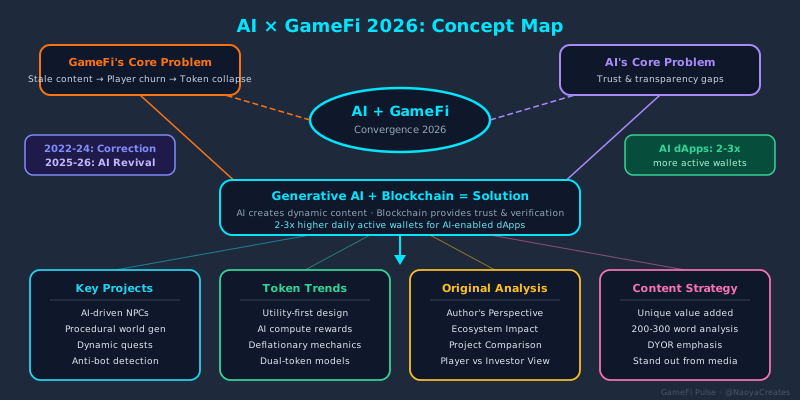
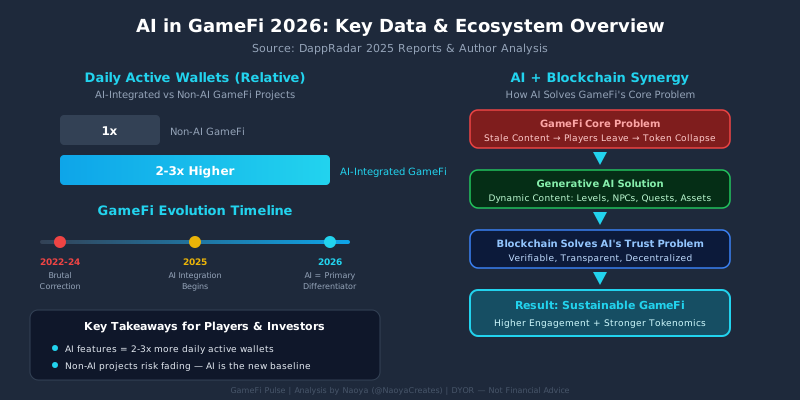
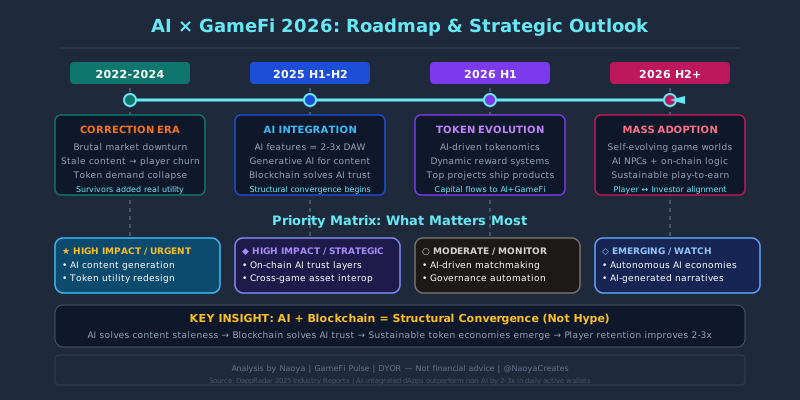
GameFi (blockchain-based gaming with financial incentives) spent 2022-2024 in a brutal correction. Projects that survived did so by adding genuine utility. In 2025 and into 2026, AI integration has become the primary differentiator between projects that attract capital and those that fade. According to DappRadar’s 2025 industry reports, blockchain gaming dApps (decentralized applications) incorporating AI features saw on average 2-3x higher daily active wallet counts compared to non-AI competitors in the same genre — though exact figures vary by quarter and methodology.
This isn’t hype recycling. The convergence is structural: generative AI (AI that creates new content like images, text, or game levels) can solve GameFi’s oldest problem — content gets stale, players leave, token demand collapses. Meanwhile, blockchain can solve AI’s trust problem — who trained the agent, what data did it use, and who owns the output?
AI doesn’t just add a feature to GameFi — it addresses the fundamental content drought that killed most Play-to-Earn games in 2022-2023. Think of AI as the engine that keeps generating fresh roads, while blockchain is the title deed proving you own the car driving on them.
Background: Three Forces Driving the Convergence
To understand why AI-GameFi projects are gaining traction in 2026, you need to see three forces colliding simultaneously.
1. Inference Costs Collapsed
Running AI models (inference) has gotten dramatically cheaper. What cost $20 per million tokens (units of text processed by AI) in early 2023 now costs under $0.10 for comparable capability through providers like Groq and open-weight models. This means game studios can afford to run AI for every player interaction — not just premium users.
2. On-Chain AI Agents Became Practical
AI agents (autonomous AI programs that take actions on behalf of users) can now interact with smart contracts (self-executing code on a blockchain) directly. Frameworks like ElizaOS and Virtuals Protocol have made it possible for AI characters to hold wallets, trade assets, and participate in game economies without human intervention. This is still early, but it’s functioning.
3. Players Demanded More Than Token Farming
The Play-to-Earn model of 2021 attracted mercenary capital. Players ground repetitive tasks, dumped tokens, and left. AI-generated content — adaptive quests, procedural worlds, personalized NPCs (non-player characters controlled by the game) — offers a reason to actually play beyond the financial incentive.
AI inference costs dropped roughly 200x in two years, making real-time AI-driven gameplay economically viable for the first time. If running a smart NPC conversation cost $0.50 per player in 2023, it now costs fractions of a penny — a shift as significant as cloud computing was for web startups.
Top AI-GameFi Projects to Watch in 2026
The following projects represent distinct approaches to merging AI with blockchain gaming. I’ve selected them based on publicly available development activity, ecosystem size, and differentiated AI integration. Note: inclusion here is not an endorsement, and token performance is inherently unpredictable.
Parallel (PRIME)
Parallel is a sci-fi trading card game built by Echelon Prime Foundation. Its AI integration runs deep: the game features AI opponents that learn from player behavior, and the studio has developed “Colony” — a survival simulation where AI agents manage resources autonomously. PRIME token powers the ecosystem across multiple game titles, creating cross-game token utility that most competitors lack.
AI Arena (NRN)
AI Arena lets players train AI fighters using imitation learning (a technique where AI learns by copying human demonstrations). Your trained AI agent fights other players’ agents in a competitive format. The NRN token is earned through ranked competition. What makes this interesting: the player’s skill isn’t in reflexes — it’s in training methodology. You’re essentially a machine learning coach.
Altered State Machine / ASM (ASTO)
ASM provides the infrastructure layer — “AI Brains” as NFTs (unique digital assets on a blockchain) that can be trained, traded, and plugged into compatible games. Think of it as creating a portable AI character that you own across multiple experiences. The ASTO token governs the protocol and is used for training operations.
Delysium (DEL)
Delysium positions itself as an AI-powered open-world game with user-generated content. AI NPCs with persistent memory interact with players differently based on past encounters. The DEL token is used for in-game transactions and governance. The project has partnerships with several AI infrastructure providers, though the full game experience is still rolling out in phases.
Ultiverse (ULTI)
Ultiverse focuses on AI-generated social gaming experiences. Their “Bodhi” protocol enables AI-driven quest generation and narrative branching. The platform aims to be a hub where multiple games share AI infrastructure and a unified token economy.
Virtuals Protocol (VIRTUAL)
While not exclusively a game, Virtuals Protocol enables the creation and co-ownership of AI agents that operate in gaming and entertainment contexts. Users can launch AI agents, tokenize them, and earn from their activities across platforms. It represents the “AI agent as asset” thesis applied to gaming environments.
I have not personally played full builds of all these titles, so I’m relying on publicly available gameplay footage, developer documentation, and community reports. Parallel and AI Arena have the most accessible current builds for testing. Always try a free demo before committing funds.
Tokenomics Comparison: How AI-GameFi Projects Distribute Value
Tokenomics (the economic design of a cryptocurrency token — supply, distribution, and incentive mechanisms) is where most GameFi projects succeed or fail. Here’s how the major AI-GameFi tokens compare across key structural dimensions.
| Project | Token | Primary AI Use | Token Utility | Supply Model | Burn/Sink Mechanism |
|---|---|---|---|---|---|
| Parallel | PRIME | Adaptive AI opponents, Colony AI agents | Cross-game currency, staking, marketplace | Fixed supply (approx. 1.11B) | Sink via in-game spending |
| AI Arena | NRN | Player-trained fighting agents | Staking for ranked rewards, training costs | Fixed supply with emission schedule | Voltage system limits play-to-earn extraction |
| ASM | ASTO | Portable AI brains (NFT-based) | Training fuel, governance | Fixed supply | Consumed during AI training operations |
| Delysium | DEL | Persistent memory NPCs, procedural content | In-game transactions, governance | Fixed supply with vesting | Transaction fees partially burned |
| Virtuals Protocol | VIRTUAL | Co-owned AI agents across platforms | Agent creation, revenue sharing | Fixed supply | Agent launch fees |
| Ultiverse | ULTI | AI quest generation, social gaming | Platform access, staking | Fixed supply with ecosystem allocation | Usage-based burning |
Key pattern to notice: Every project in this table uses a fixed or capped token supply. This is a hard-learned lesson from 2021-2022 GameFi, where infinite-emission tokens (like the original SLP from Axie Infinity) collapsed under sell pressure. The AI integration creates natural token sinks — training AI costs tokens, which are consumed, reducing circulating supply. This is structurally healthier than pure play-to-earn emission models.
If you value infrastructure plays that could serve multiple games, look at ASM (ASTO) and Virtuals (VIRTUAL). If you prefer investing in a specific game with playable builds today, Parallel (PRIME) and AI Arena (NRN) are further along. Neither path is inherently safer — both carry significant risk.
How AI Changes the GameFi Flywheel
Traditional GameFi followed a predictable cycle: launch token → attract players with rewards → content stagnates → players sell tokens → death spiral. AI potentially breaks this loop in three concrete ways.
Dynamic Content Generation
Instead of a fixed quest library that players exhaust in weeks, AI can generate variations indefinitely. Delysium’s approach — NPCs that remember your previous interactions and adapt their dialogue and quest offerings — means two players can have fundamentally different experiences. This extends content lifespan without proportional development costs.
Skill-Based Earning (Not Time-Based)
AI Arena represents a shift that matters: your earnings depend on how well you train your AI agent, not how many hours you grind. This attracts a different player profile — one more likely to stay engaged and less likely to pure-farm-and-dump. For the average user, this means the meta-game shifts from “who has more time” to “who understands AI training better.”
AI Agents as Economic Participants
This is the most speculative but potentially transformative development. AI agents holding wallets, participating in token economies, providing liquidity, or completing bounties. Virtuals Protocol is building toward this. If it works, game economies become more liquid and active even during low-human-player periods. If it doesn’t work well, it could also introduce manipulation risks.
If you’re a content creator, marketer, or community manager in Web3, the AI-GameFi convergence creates demand for a new skill: “AI trainer” as a player role. Understanding basic prompt engineering and reinforcement learning concepts will likely become valuable in gaming communities, not just developer circles.
Risks That Don’t Get Enough Airtime
It’s easy to get excited. Here’s what should temper that excitement.
Centralization Under the Hood
Most “AI-powered” blockchain games run their AI models on centralized servers. The blockchain part handles token transfers and NFT ownership, but the actual intelligence lives on AWS or Google Cloud. If the team shuts down those servers, the “AI” part of your AI-GameFi investment vanishes. Truly decentralized AI inference is improving (projects like Ritual and Gensyn are working on it), but it’s not yet standard in gaming.
Regulatory Uncertainty
AI-generated content raises unresolved legal questions. If an AI creates a game asset, who owns the copyright? If an AI agent trades tokens autonomously and causes a market disruption, who’s liable? These questions don’t have clear answers yet in most jurisdictions. This creates real risk for projects and token holders.
The “AI Wrapper” Problem
Some projects slap an AI label on basic automation and call it revolutionary. A chatbot NPC that uses a standard LLM (large language model — the technology behind ChatGPT) API call is not the same as a project with deeply integrated, purpose-trained AI systems. Evaluating the depth of AI integration matters enormously. Look for projects that publish technical documentation about their AI architecture, not just marketing claims.
The biggest risk isn’t that AI-GameFi fails — it’s that you invest in a project claiming deep AI integration that’s actually just a chatbot with a token. Always check: is the AI running on-chain or off-chain? What happens if the company’s servers go offline? Can you access the AI model’s documentation?
What This Means for Your Daily Life
If you use ChatGPT every day but haven’t touched GameFi, here’s why this convergence might eventually affect you.
Gaming habits will shift. Within 12-18 months, mainstream games (not just crypto-native titles) will likely incorporate AI-generated content as standard. The blockchain-native projects discussed here are testing these mechanics first, but the patterns — adaptive NPCs, player-trained AI, procedural quests — will spread industry-wide.
New income streams will emerge. “AI training” as a player skill could create a new gig economy category. Imagine being paid (in tokens or fiat) for training better AI opponents, designing AI behaviors, or curating training data through gameplay. This isn’t guaranteed, but the infrastructure is being laid right now.
Your AI skills transfer. If you already know how to write effective prompts for ChatGPT, you have a head start in games that require training or directing AI agents. Prompt engineering (the skill of crafting effective instructions for AI) isn’t just for work productivity — it’s becoming a competitive gaming skill.
You don’t need to buy any tokens today. Start by creating a free account on AI Arena or watching Parallel Colony gameplay streams. Understanding how AI-agent training works in a game context will prepare you for opportunities in this space — whether as a player, creator, or investor.
Summary: Three Points That Matter
1. AI solves GameFi’s content problem. The death spiral of old play-to-earn models was driven by finite content and infinite token emissions. AI-generated content extends engagement; fixed-supply tokens with AI-driven burn mechanisms create healthier economics.
2. Not all AI-GameFi is equal. The spectrum ranges from shallow chatbot integrations to deeply embedded AI training systems. Projects like AI Arena (where player skill is literally AI training ability) represent the deeper end. Always evaluate the technical substance behind the marketing.
3. The infrastructure layer may outperform individual games. Just as Ethereum outperformed most individual dApps built on it, AI-agent infrastructure (ASM, Virtuals Protocol) could capture more value than any single AI game — if adoption spreads across multiple titles.
Author’s Take
I’ve been tracking GameFi since the Axie Infinity era, and the AI integration wave feels fundamentally different from previous hype cycles (metaverse, move-to-earn). The difference is functional utility. AI actually makes games better to play — it’s not just a financial engineering trick. That said, I’m cautious about timelines. Most of these projects are still in early stages, and the gap between demo-day impressive and daily-play-for-months engaging is enormous. My honest assessment: 2-3 projects from this cohort will likely become significant, and the rest will fade. The challenge, as always, is identifying which ones in advance. I’d weight my attention (and any capital, if investing) toward projects with playable builds today over those selling visions of tomorrow.
Next Steps: What You Can Do Today
1. Try a free AI-GameFi experience. AI Arena offers browser-based gameplay where you can train AI fighters without purchasing tokens. Spend 30 minutes understanding how the training loop works. This hands-on experience is worth more than any article (including this one).
2. Set up tracking for key tokens. Add PRIME, NRN, ASTO, VIRTUAL, and DEL to a free portfolio tracker like CoinGecko. You’re not buying — you’re observing. Watch how token prices correlate with development milestones and player count changes over 2-3 months before considering any financial position.
3. Join one project’s community. Pick the project whose game genre interests you most and join their Discord or follow their developer updates. Community health (active discussions about gameplay, not just token price) is one of the best leading indicators of project longevity. Pay attention to whether players talk about fun or just about profits.
Data Sources
- Echelon Prime Foundation (Parallel / PRIME) — Official project site and tokenomics documentation
- AI Arena — Official site with gameplay mechanics and NRN token details
- Altered State Machine (ASM / ASTO) — AI Brain NFT infrastructure documentation
- Delysium — Official project site with AI NPC technical overview
- Virtuals Protocol — AI agent co-ownership platform documentation
- Ultiverse — Official platform for AI-driven social gaming
- DappRadar — Blockchain Games Rankings — Industry tracking for active wallet counts and game engagement metrics
- CoinGecko — Token market data and portfolio tracking
Original Analysis: Player vs. Investor Perspective & Ecosystem Impact
From the Player’s Perspective: The AI-GameFi convergence is the most promising development for actual gameplay quality since blockchain gaming began. Previous waves (play-to-earn, move-to-earn) optimized for financial extraction, not entertainment. AI integration — when done well — optimizes for engagement first, and tokenized rewards become a secondary benefit rather than the sole reason to log in. For players, the key question is straightforward: “Would I play this game if there were no token rewards?” If the answer is yes, the AI integration is likely substantive. If the answer is no, you’re looking at another dressed-up yield farm, regardless of how sophisticated the AI marketing sounds.
From the Investor’s Perspective: Token sink mechanisms powered by AI training represent a genuine structural improvement over older GameFi models. When training an AI agent consumes tokens permanently, it creates deflationary pressure that doesn’t rely on constant new user influx — the Ponzi-adjacent problem that destroyed previous cycles. However, investors should watch token unlock schedules carefully. Several projects in this cohort still have significant team and VC allocations that will vest through 2026. A great AI product with bad token distribution timing can still see price declines even as usage grows.
Ecosystem Impact: The broader GameFi ecosystem likely benefits from AI integration even if specific projects fail. The tooling being developed — on-chain AI agents, portable trained models as NFTs, inference verification — creates reusable infrastructure. If ASM’s “AI Brain” standard gains adoption, for example, it could become a composability layer similar to what ERC-721 did for NFTs: a shared standard that lifts all compliant projects. The risk is fragmentation — too many incompatible AI agent standards competing for developer attention. Watch for consolidation signals: partnerships between infrastructure projects and game studios, shared SDKs (software development kits), and cross-game agent portability. That’s where the real ecosystem value will crystallize.
Disclaimer: The information on this site is for educational and informational purposes only and should not be considered financial or investment advice. In-game assets and tokens carry significant risk. Always do your own research (DYOR) before making any investment decisions.
About the Author: Naoya is a Web3 researcher specializing in GameFi, blockchain gaming, and Play-to-Earn ecosystems. He analyzes the latest GameFi projects and tokenomics from both player and investor perspectives.
🔗 Follow on X: @NaoyaCreates