In my view, Yuga Labs owning the tech stack signals a push for better economic stability#GameFi #Metaverse
Quick Video Breakdown: This Blog Article
This video clearly explains this blog article.
Even if you don’t have time to read the text, you can quickly grasp the key points through this video. Please check it out!
If you find this video helpful, please follow the YouTube channel “GameFi+Plus,” which delivers daily news.
https://www.youtube.com/@GameFiPulse
Read this article in your native language (10+ supported) 👉
[Read in your language]
Yuga Labs’ Acquisition of Improbable’s Platform: Implications for Otherside’s GameFi Ecosystem
🎮 Gameplay Type: Metaverse Sandbox (Exploration, Building, Social Interaction)
👍 Recommended For: NFT Investors, Metaverse Developers, Blockchain Economy Analysts
In the evolving landscape of GameFi and metaverse projects, Yuga Labs’ recent acquisition of Improbable’s Unreal Engine-based platform marks a significant shift in infrastructure control. Announced just two weeks ago, this move brings the core technology powering Otherside—the company’s flagship metaverse game—fully in-house. Drawing from official announcements and industry reports, such as those from PlayToEarn, the deal includes a permanent license for high-concurrency tech and the integration of Improbable’s development team starting early 2026. This acquisition isn’t just about tech; it underscores Yuga Labs’ commitment to refining Otherside’s GameFi elements, where NFTs and tokenomics intersect with immersive gameplay. Structurally, it positions Otherside as a more self-reliant ecosystem, potentially addressing long-standing concerns around scalability and economic sustainability in blockchain gaming.
The “Before” State: Web2 Gaming vs. GameFi Ownership
Traditional Web2 games, like Fortnite or Roblox, operate on centralized servers where players invest time and money into virtual assets that remain locked within the publisher’s ecosystem. Once servers shut down or policies change, those investments evaporate—think of it as renting a skin or item that can be revoked at any time. In contrast, GameFi projects like Otherside leverage blockchain for true ownership via NFTs. Players can buy, sell, or trade assets on secondary markets, creating real economic value. This acquisition enhances that model by internalizing development, reducing dependency on third-party tech and potentially stabilizing the economy against external disruptions.
Core Mechanism: Tokenomics and Economic Design
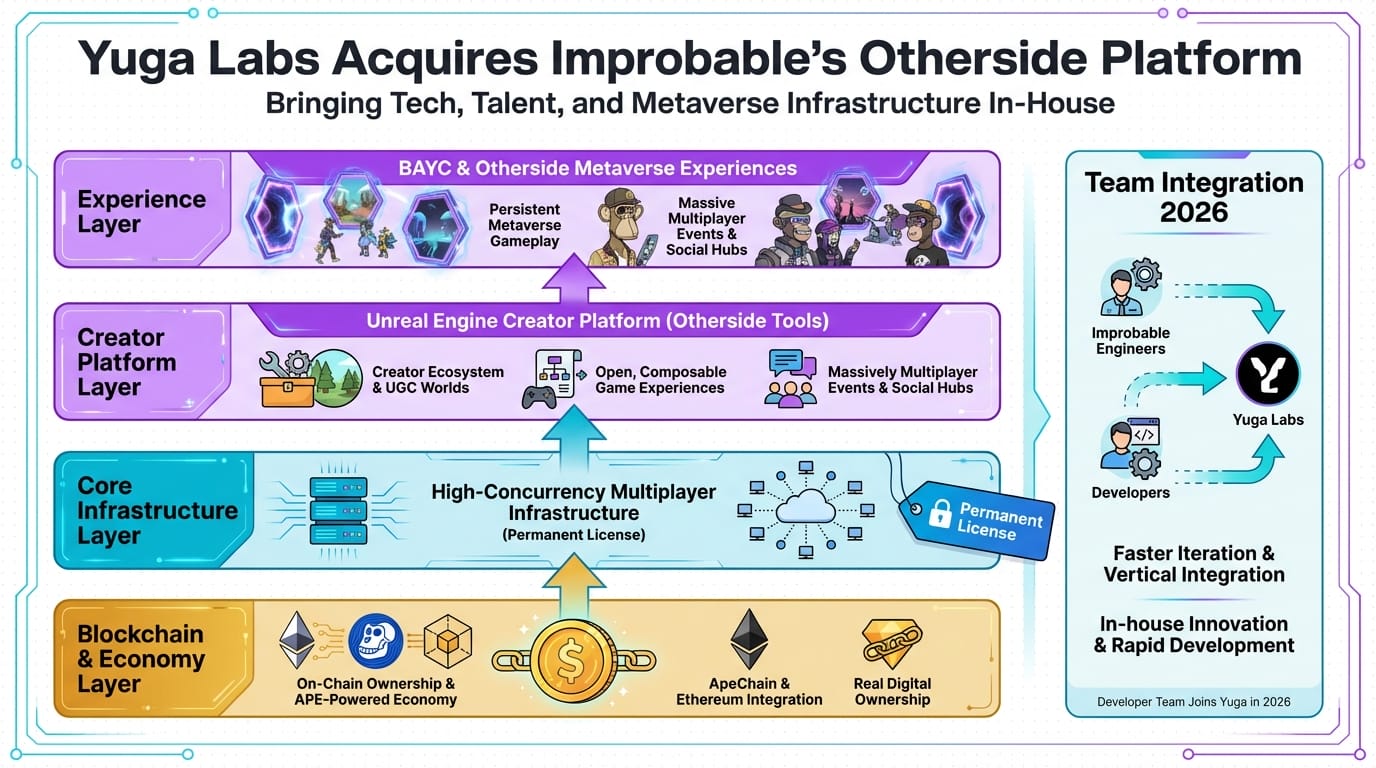
At the heart of Otherside’s GameFi design is its token economy, primarily revolving around the APE token (built on Ethereum) and NFTs representing virtual land and assets. Token emission occurs through gameplay rewards, staking incentives, and ecosystem partnerships, with a total supply capped at 1 billion APE. However, post-acquisition, Yuga Labs gains greater control over integrating Unreal Engine’s capabilities with blockchain elements, potentially optimizing emission rates to avoid hyperinflation—a common pitfall in GameFi.
Key to sustainability is the balance between token sinks and emissions. Token sinks, such as burning mechanisms for in-game upgrades or fees for land development, help counteract inflation by removing tokens from circulation. For instance, developing virtual plots in Otherside requires APE expenditure, which could be burned or locked, drawing parallels to real-world real estate taxes. On the risk side, if emissions outpace sinks—say, through unchecked reward farming—the token’s value could plummet, leading to player exodus. Analytics from sources like Dune Dashboards show APE’s historical volatility, with past dumps tied to over-emission during hype cycles.
The acquisition introduces structural improvements: by owning the platform, Yuga Labs can implement on-chain governance more seamlessly, perhaps using DAO-like structures for community-driven sink adjustments. Long-term risks include centralization—despite blockchain’s decentralized ethos, in-house control might concentrate power, raising concerns about transparency. Objective data from Etherscan reveals that APE’s smart contracts have undergone audits by firms like PeckShield, but post-2026 updates will need monitoring for new vulnerabilities.
Use Cases / Play Styles
Participation in Otherside can vary based on user goals, always factoring in market dynamics and personal risk tolerance.
First, as an NFT collector and builder, one might focus on acquiring virtual land parcels (represented as NFTs) and developing them into interactive spaces. This involves using APE to customize environments, attracting visitors for social events, with potential value appreciation if the metaverse grows—though outcomes depend on broader adoption.
Second, for economy participants, staking APE in liquidity pools (pots of money enabling instant token trades) or providing liquidity on platforms like Uniswap could offer rewards. This style suits those analyzing on-chain data via tools like DexScreener, balancing yields against impermanent loss risks from price fluctuations.
Third, developers and creators might leverage the acquired Unreal Engine tools to build custom experiences within Otherside, earning APE through community contributions. This requires technical skills and could involve collaborating via Yuga’s ecosystem, but success hinges on user engagement and not on guaranteed returns.
Comparison: Traditional Web2 Game vs. This GameFi Project
| Aspect | Traditional Web2 Game (e.g., Roblox) | Otherside (GameFi Project) |
|---|---|---|
| Ownership | Publisher-controlled; assets can be lost if service ends | Blockchain-based NFTs; true ownership via wallets |
| Progression | In-game levels reset or are non-transferable | Progress tied to tradeable NFTs and tokens |
| Economy Design | Centralized microtransactions; no real-world value | Decentralized tokenomics with sinks and emissions |
Conclusion
Yuga Labs’ acquisition strengthens Otherside’s design by consolidating tech and talent, offering valuable lessons in metaverse infrastructure and token economy balance. Strengths include enhanced scalability and potential for robust sinks to ensure sustainability, while risks like inflation and centralization warrant caution. Ultimately, outcomes depend on player behavior, market conditions, and ongoing developments—always verify on-chain data and start small to understand the ecosystem.

👨💻 Author: SnowJon (Web3 & AI Practitioner / Researcher)
A researcher leveraging insights from the University of Tokyo Blockchain Innovation Program to analyze GameFi, Web3, and digital economies from a practical and structural perspective.
His focus is on translating complex systems into frameworks that readers can evaluate and think about critically.
*AI may assist with drafting, but final verification and responsibility rest with the human author.
References & Further Reading
- Yuga Labs Acquires Improbable’s Unreal Engine Platform and Dev Team | PlayToEarn
- Yuga Labs’ Strategic Acquisition of Improbable’s Unreal Engine Platform and Its Implications for the Metaverse Ecosystem
- Yuga Labs Acquires Otherside Creator Platform From Improbable
- Improbable sells Imporium to its long-standing partner, Yuga Labs
▼ AI tools to streamline research and content production (free tiers may be available)
Free AI search & fact-checking
👉 Genspark
Recommended use: Quickly verify key claims and track down primary sources before publishing
Ultra-fast slides & pitch decks (free trial may be available)
👉 Gamma
Recommended use: Turn your article outline into a clean slide deck for sharing and repurposing
Auto-convert trending articles into short-form videos (free trial may be available)
👉 Revid.ai
Recommended use: Generate short-video scripts and visuals from your headline/section structure
Faceless explainer video generation (free creation may be available)
👉 Nolang
Recommended use: Create narrated explainer videos from bullet points or simple diagrams
Full task automation (start from a free plan)
👉 Make.com
Recommended use: Automate your workflow from publishing → social posting → logging → next-task creation
※Links may include affiliate tracking, and free tiers/features can change; please check each official site for the latest details.